

Andevalo Perfume: A Considered Guide to Its Scent and Character
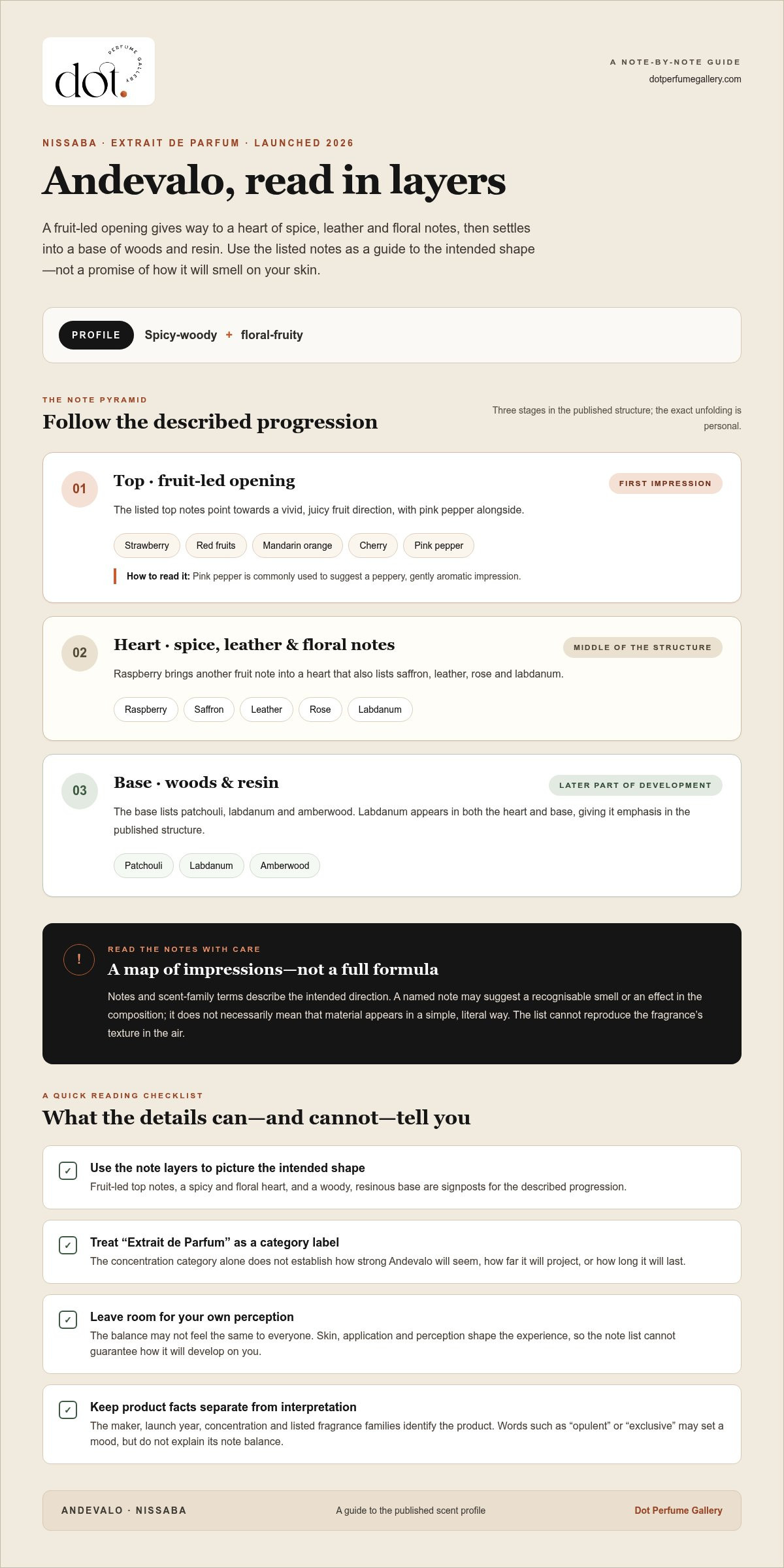
What if the best clue to whether a perfume suits you lies not in its first bright impression, but in what gathers beneath it? Andevalo perfume, launched by Nissaba in 2026, pairs a vivid fruit opening with notes that suggest a deeper, warmer character. Its listed top notes include strawberry, red fruits, mandarin, cherry and pink pepper; saffron, leather, rose and labdanum shape the heart, with patchouli, labdanum and amberwood in the base.
It’s understandable if that list still leaves you wondering what the fragrance might feel like on your skin. Notes offer a useful map, but they don’t always make it easy to picture the shift from juicy fruit to resinous warmth, or to know whether that contrast suits your taste. Andevalo’s inspiration in a landscape known for its heat and cistus-rich character gives its labdanum a particular sense of place.
This guide brings the product details into clearer focus, translating the listed notes into familiar scent impressions without promising how the perfume will wear on you. We’ll consider its fruity, spicy, woody and floral facets, then offer a practical way to decide whether Andevalo feels like a natural fit.
Key Takeaways
- Separate reliable product details from impressions that depend on your own senses.
- Use the Andevalo perfume profile to compare its listed notes with your preferences, and consider the contrasts that may appeal to you.
- Assess a scent on a paper strip and on skin as two different experiences, rather than expecting them to smell identical.
- Explore niche fragrances at Dot Perfume Gallery as a starting point for discovering your preferences.
Why Andevalo perfume invites a closer look
What can reliable information tell you about Andevalo, beyond the atmosphere created by a polished perfume description? Start by separating stated product details from impressions you might draw from them. Andevalo is a Nissaba fragrance, launched in 2026, and is available from Dot Perfume Gallery. Those details identify the product without relying on broad claims about luxury or rarity to tell you how it might smell.
In brief: Andevalo is a Nissaba Extrait de Parfum, described as spicy-woody and floral-fruity. “Extrait de Parfum” is a fragrance concentration category; the label alone doesn’t tell you exactly how the scent will develop, project or last on your skin. Use the category and scent description to decide whether it is worth exploring, then rely on your own experience to judge whether it feels like yours.
What the available Andevalo details establish
The maker, launch year, concentration and stated fragrance families are product facts. They give you more to work with than words such as “opulent” or “exclusive”, which may set a mood but don’t identify a scent’s character. “Spicy-woody” and “floral-fruity” are broad family descriptions, not a complete formula. Use them to frame the product, then look at the individual notes to understand the balance described.
It’s also useful to understand what a concentration label can and can’t establish. Extrait de Parfum describes a category of perfume concentration, but it shouldn’t be treated as a promise of a particular strength or duration on every wearer. Skin, application and perception all shape the experience. The International Fragrance Association (IFRA) represents the fragrance industry and publishes standards concerning fragrance materials. That wider industry context is separate from Andevalo’s scent description and doesn’t, by itself, establish product-specific performance.
What a fragrance description can, and cannot, tell you
Notes and scent-family terms are best read as a guide to the impression a perfumer intends to create, rather than a full ingredient list. A note may describe a recognisable smell or an effect in the composition; it doesn’t necessarily mean that the named material appears in the formula in a simple, literal way. Product language can point towards a scent’s direction, but it can’t reproduce its texture in the air.
Nor will a description guarantee that everyone experiences the same balance. “Woody” may feel dry and understated to one wearer, yet warmer to another. That’s a reminder that scent is personal, not a flaw in the description. In the next section, we’ll stay close to Andevalo’s published notes and translate them into approachable impressions, while distinguishing interpretation from fact. This gives you a clearer starting point and leaves room for your own judgement.
Andevalo perfume’s scent profile: read the details with care
A note list is most useful when read as a sequence of impressions, rather than a literal inventory of every material in a formula. Nissaba describes Andevalo as spicy-woody and floral-fruity, with notes arranged across the top, heart and base. These terms help you picture the fragrance’s intended shape; they can’t tell you exactly how it will unfold on your skin.
In one sentence: Andevalo moves from strawberry, red fruits, mandarin, cherry and pink pepper in the top notes to raspberry, saffron, leather, rose and labdanum in the heart, settling into patchouli, labdanum and amberwood in the base.
How to understand Andevalo’s listed notes
The listed top notes give the opening a fruit-led direction: strawberry, red fruits, mandarin orange and cherry sit alongside pink pepper, a note commonly used to suggest a peppery, gently aromatic impression. The heart names raspberry, saffron, leather, rose and labdanum. Treat these as signposts, not a guarantee that each note will be equally apparent to every wearer.
The base lists patchouli, labdanum and amberwood. In a note pyramid, “base” refers to the materials or impressions assigned to the later part of a fragrance’s development; it doesn’t promise a particular duration. Labdanum appears in both the heart and base, giving it emphasis in the published structure. The list describes the composition’s intended progression, not a complete formula or a prediction of exactly when each note will emerge.
Keeping description and interpretation separate makes the note list more useful. “Fruit-led opening” summarises the named top notes; imagining a particular texture or mood is your own reading, not a product fact. For another perspective on how the scent may be understood beyond its initial impression, explore Andevalo beyond the first impression.
What fragrance concentration means for a shopper
Andevalo is labelled an Extrait de Parfum. This is a concentration category used on fragrance products, but the term alone doesn’t establish how strong a perfume will seem, how far it will project, or how long it will last. Those are product-specific and wearer-specific experiences, so it’s wiser not to infer them from the word “Extrait”.
Concentration labels also aren’t a substitute for ingredient or safety information. The U.S. Food and Drug Administration (FDA) provides information about cosmetics and fragrances within the United States; that reference offers broader consumer context, not a scent assessment of Andevalo or UK-specific guidance. For this fragrance, the practical approach is simple: use the stated concentration to identify the product category, and the notes to understand its described direction.
If the blend of fruit, spice, floral notes and woods sounds worth exploring, browse Andevalo at Dot Perfume Gallery. Keep the listed profile in mind while you form your own impression.
How to decide whether Andevalo suits your fragrance preferences
A fragrance description can narrow the field, but it can’t tell you in advance whether you’ll want to wear a scent. Use Andevalo’s published profile as a set of clues, then compare those clues with what you already enjoy: fruit, spice, florals, leather-like impressions or woody notes. The aim isn’t to find a perfect label match. Notice which parts invite you closer and which give you pause.
Match verified scent characteristics to what you already enjoy
Think of fragrances you reach for willingly. Do you enjoy juicy fruit notes, or prefer fruit balanced by spice and deeper woods? Are rose and other floral impressions familiar pleasures, or do leather and resinous labdanum sound more intriguing? The Andevalo perfume profile includes each of these directions. Your preferences can help you decide what to pay attention to, without predicting exactly how the blend will smell to you.
| Verified characteristic | Preference it may suit | What to consider |
|---|---|---|
| Strawberry, red fruits, mandarin, cherry and raspberry are listed notes | You enjoy fruit-led fragrance descriptions or like fruit balanced with other facets | The note list doesn’t establish how sweet, fresh or prominent the fruit will seem to you. |
| Pink pepper and saffron appear in the listed notes | You’re curious about a spicy accent alongside fruit and florals | Spice is one part of the profile; the description doesn’t tell you its precise intensity. |
| Rose and leather are listed in the heart | You’re drawn to floral notes with a contrast in character | Consider whether you enjoy this combination in principle, whilst keeping an open mind about its balance. |
| Patchouli, labdanum and amberwood are listed in the base | You appreciate woody or resin-associated notes in a fragrance | A listed base isn’t a promise of a particular dry-down or lasting power. |
Use these prompts to make a shortlist of what you’d like to notice, rather than treating them as rules. The American Chemical Society’s explanation of perfume chemistry offers broader context for the chemistry behind fragrance. A note name, however, remains a guide to a scent impression, not a guarantee of how you’ll experience it. Your own encounter with the perfume is the best way to judge personal affinity.
Consider the mood and moments you want a fragrance to accompany
Think about when you tend to enjoy wearing perfume: during a quiet morning, on an evening out, or simply as a private pleasure at home. You might also consider whether fruit and spice appeal to you in warmer weather, cooler weather, or either. These are personal associations, not fixed seasonal or occasion rules, and the published profile alone can’t prescribe where Andevalo belongs.
If the combination of fruit, florals, spice and woods gives you something to explore, take a considered look at Andevalo at Dot Perfume Gallery. Let the listed characteristics guide your curiosity, then trust your own response to decide whether the fragrance feels at home among your favourites.
How to assess Andevalo thoughtfully before choosing it
A considered choice needn’t begin with certainty. Start with the reliable description, note which parts speak to your preferences, then let the scent itself add what a note list can’t. This pause between reading and deciding helps you approach Andevalo with curiosity rather than expecting it to smell a particular way.
A simple fragrance assessment, step by step
- Read the product details. Note the stated scent families and listed notes, then pick out the details that matter to you. Perhaps you’re drawn to fruit, or curious about the contrast of floral and woody impressions. Keep your shortlist personal and uncomplicated.
- Smell it on a paper strip and on skin, if you can. A paper strip offers one view of a fragrance; skin can present it differently. Neither is a definitive preview of every future wear, so treat each as a useful observation rather than a verdict.
- Give your impressions room to settle. Notice what you can actually smell instead of trying to identify every listed note. You might record a few words, such as “fruit-forward”, “softly spicy” or “not quite for me”. These are personal observations, not claims about the formula.
- Reflect before deciding. Ask whether the experience felt comfortable, familiar, intriguing or tiring. Consider whether you’d welcome that impression again, rather than choosing solely because a description sounds appealing.
A paper strip and your skin are different ways of encountering a fragrance; neither guarantees the same impression as the other, or as another person’s experience. If you’re considering a scent without being able to smell it first, this guide to buying perfume without testing offers further practical ways to make a measured decision.
Separate first impressions from lasting preference
The first moment is only one part of your response. A fragrance may seem vivid at first, then feel more familiar as you continue to notice it; equally, an initially appealing impression may not become something you enjoy wearing. This is a possibility, not a promise about how Andevalo develops or how long it lasts.
A first impression tells you what you notice at the outset; a considered personal assessment asks whether you enjoy the fragrance as you experience it. Listen for comfort as much as surprise. Does the scent feel easy to be around? Does it call to mind a fragrance family you already love, or offer an appealing change of direction? Your answers matter more than matching a description word for word.
There’s no need to force a conclusion. If the profile leaves you curious, browse Andevalo at Dot Perfume Gallery and use your own preferences as the guide. The aim isn’t to approve of every note on paper, but to decide whether the fragrance feels like a welcome part of your scent wardrobe.
Explore Andevalo at Dot Perfume Gallery
A thoughtful choice brings together what the product information establishes and what you personally enjoy wearing. Andevalo is available from Dot Perfume Gallery, an independent retailer curating niche, luxury and British fragrances from multiple perfume houses. Its published profile gives you a considered starting point, but your own response remains the measure of whether it belongs in your fragrance wardrobe.
Before taking the next step, revisit the details that caught your attention. Was it the fruit-led direction, the floral and spicy facets, or the woody notes that made you curious? Set those impressions beside your own preferences: the scents you return to, the textures you find comforting, and the notes you’re ready to discover. You don’t need to be certain. Curiosity is reason enough to explore further.
A considered next step for curious fragrance shoppers
Dot Perfume Gallery offers Andevalo alongside a curated selection of niche fragrances, giving you the opportunity to explore beyond a single product description. Take your time with the information, keep your own taste in view, and allow room for the scent to surprise you. No written profile can decide on your behalf; the final judgement belongs to the wearer.
If Andevalo feels like a promising possibility, explore Andevalo at Dot Perfume Gallery. Use the published profile as a starting point, not a prediction of exactly what you’ll smell. It may fit what you already love, or open a new direction in your preferences. Either response is useful when choosing a fragrance for yourself.
When a personal perfume consultation may help
Sometimes the harder question isn’t whether one fragrance sounds appealing, but how to understand your preferences across a wider choice. Dot Perfume Gallery’s private perfume consultations offer an opportunity to explore individual fragrance tastes. They’re available by appointment on Tuesday to Thursday evenings.
You might use a consultation to describe the scents you feel most at ease wearing, the notes that draw you in, or the impressions you’d like to explore. There’s no need to arrive with a perfectly formed vocabulary; everyday words such as fresh, soft, rich or familiar can be a helpful beginning. The value lies in making space for your own preferences, rather than following a rule about what you ought to enjoy.
Whether you browse independently or choose a consultation as part of a wider search, keep your own judgement at the centre. Product details can bring the fragrance into focus; your experience gives those details meaning. Andevalo may become a favourite, or simply a scent you’re glad to have discovered. Either way, a considered choice begins with paying attention to what feels right to you.
Let your own impression lead the way
Choosing a fragrance is less about finding the perfect description than noticing how a scent makes you feel. As you consider Andevalo perfume, let curiosity sit alongside discernment: which details draw you in, and which would you want to experience for yourself? Your answer needn’t be immediate. A fragrance can be an invitation to explore, rather than a decision you have to make at once.
Dot Perfume Gallery offers a place to continue that exploration, with an independent selection of niche, luxury and British fragrances. To return to Andevalo with your own preferences in mind, explore Andevalo at Dot Perfume Gallery. Private perfume consultations, available by appointment Tuesday to Thursday evenings, can also support a wider journey of fragrance discovery.
Take the next step at your own pace. Whether Andevalo becomes a scent you reach for often or simply an intriguing discovery, the most meaningful choice is the one that feels truly yours. Explore Andevalo at Dot Perfume Gallery and find your next fragrance to discover.
Frequently Asked Questions
Who makes Andevalo perfume?
Andevalo is made by Nissaba, a Swiss niche perfume house. Knowing the maker helps you place the fragrance within the brand’s work, but it won’t tell you whether you’ll enjoy wearing it. Use the product description as a starting point and compare its stated character with scents you already like. If you’re curious about the wider house, explore its other fragrances alongside Andevalo rather than judging by its name alone.
What does extrait mean in perfumery?
Extrait, short for Extrait de Parfum, is a category used to describe a perfume’s concentration. It identifies the product type, but doesn’t set a universal standard for how noticeable the fragrance will seem or how long it will last. If you’re comparing labels, treat concentration as one piece of information, not a reliable shortcut to performance. Your own perception and the way you apply a scent also affect the experience.
Are perfume notes the same as a fragrance’s ingredients?
No. Notes are terms used to describe the smells or impressions a fragrance is designed to evoke; they aren’t necessarily a complete list of the materials in its formula. For instance, a perfume described with a rose note may suggest a rose-like impression without the note label explaining exactly how that effect is created. Read notes as a helpful guide to character, not as an ingredient declaration or full formula.
Can the same perfume smell different on different people?
Yes, people can experience the same perfume differently. Skin, the amount applied, surroundings and individual perception can all influence what someone notices. One wearer might focus on a bright opening, whilst another notices a softer or warmer aspect. This doesn’t mean either person is smelling it incorrectly. If you’re choosing for yourself, your own experience is more useful than expecting the scent to match another person’s description exactly.
Is Andevalo perfume a good gift?
It may be a thoughtful gift if you have a sense of the recipient’s fragrance preferences, especially whether they enjoy fruit, spice, floral notes or woody impressions. If their taste is less familiar, a full bottle can feel more uncertain: a beautifully written profile can’t guarantee personal affinity. Consider how they usually choose perfume and whether they enjoy discovering unfamiliar scents. The best gift feels attentive to the person, not simply to the packaging.
How should I store perfume at home?
Keep perfume in a cool, dry place away from direct sunlight and frequent temperature changes. A bedroom drawer or cupboard is generally more suitable than a sunny windowsill or a steamy bathroom. Keeping the bottle in its original box can help shield it from light, and replacing the cap after use helps limit exposure to air. These simple habits support careful storage, though they can’t guarantee that a fragrance will remain unchanged indefinitely.
How can I choose a perfume when I cannot smell it first?
Start by listing fragrances and scent families you already enjoy, then compare those preferences with the product’s published description. For Andevalo, consider whether its stated notes sound appealing, while remembering that descriptions can’t reproduce the scent or promise how you’ll experience it. Look for clear product information and take time over the decision rather than relying on a single evocative phrase. A private perfume consultation at Dot Perfume Gallery can also help you explore your preferences more broadly.