

Choose a Fragrance for a Special Occasion by Event and Scent
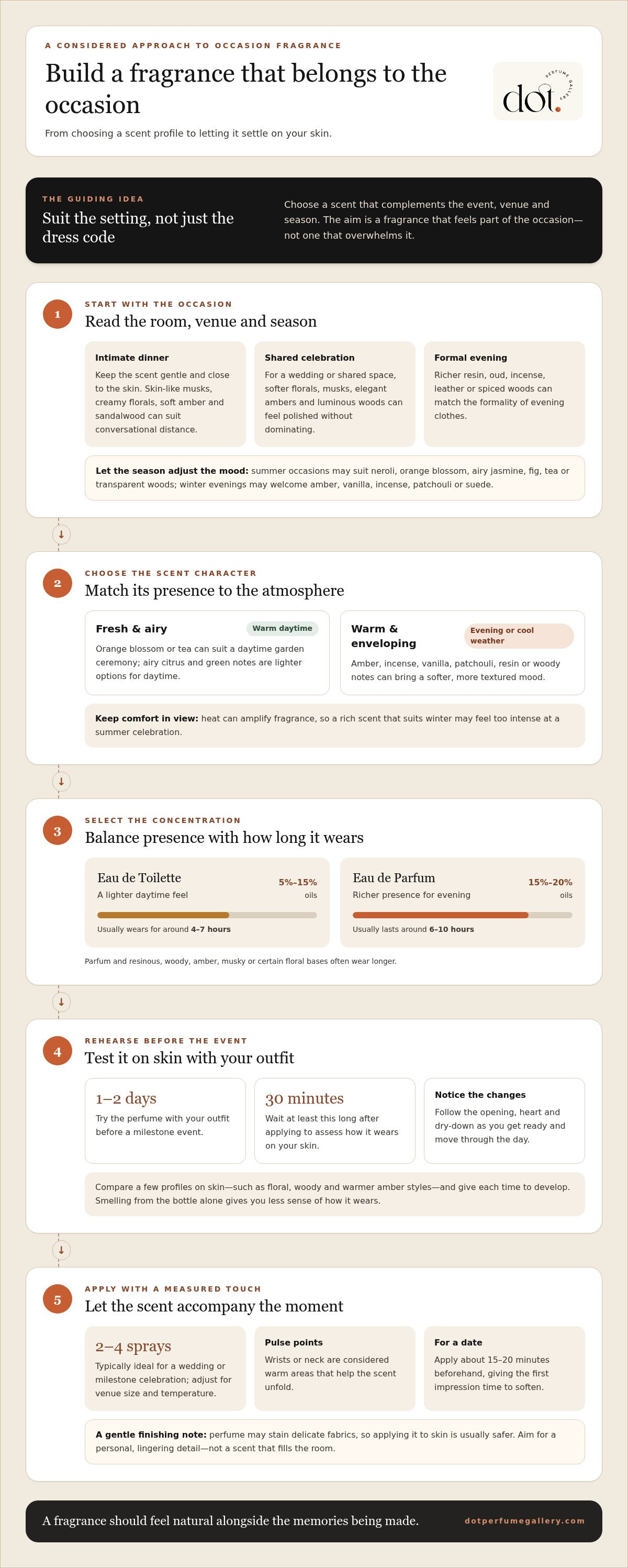
The boldest perfume isn’t always the best fragrance for a special occasion; a scent that suits the event, setting and season often leaves the more graceful impression. For an evening celebration, Eau de Parfum, with 15% to 20% oils, can offer a richer presence, whilst Eau de Toilette, with 5% to 15%, is a lighter choice for daytime. The aim is a fragrance that feels like part of the occasion, not one that overwhelms it.
It’s natural to want a fragrance for a special occasion that feels distinctive, whether you’re celebrating an anniversary, attending a wedding or going to a formal gathering. The right choice depends on more than a favourite bottle: warmth can amplify a scent, and an intimate dinner calls for a different presence from a grand celebration.
This guide explores how to match scent profiles and concentration to the mood of the event, from soft florals and musks to deeper amber and woods. You’ll also find practical ways to test and apply your chosen perfume so it settles comfortably on your skin and lingers in a way that feels quietly, unmistakably yours.
Key Takeaways
- Choose a scent to suit the event’s atmosphere, setting and season, rather than relying on formality alone.
- Try your chosen perfume with your outfit 1-2 days before a milestone event to see how it wears on your skin.
- For summer celebrations, consider airy floral or green notes; for winter evenings, warmer amber, vanilla or woody profiles may feel more at home.
- Match concentration to the occasion: Eau de Toilette offers a lighter daytime feel, whilst Eau de Parfum can bring more presence to an evening.
- Look beyond gendered labels and choose notes, intensity and lasting presence that feel comfortable and personal to you.
1. Fragrance for anniversaries and milestone events
An anniversary fragrance can become part of the occasion’s memory, recalling a particular evening whenever its notes return. Bouquet de La Reine was crafted as a wedding gift for Queen Victoria in 1840, a reminder of perfume’s long connection with celebration. For your own milestone, choose a scent that feels personal: perhaps a familiar floral, a soft musk, or a new composition that suits the mood you want to remember.
Let the setting guide the fragrance’s character. An intimate anniversary dinner calls for a gentle trail close to the skin, while a spacious outdoor celebration can carry a more noticeable scent. Consider the venue, season and clothes you’ll wear. Patchouli can bring grounded, earthy warmth; pink pepper offers a brighter, sparkling opening. These are examples, not rules, so follow what feels comfortable on your skin.
Try the perfume with your outfit 1-2 days before the event. Apply it to your skin, then notice how its opening, heart and dry-down develop as you get ready and move through the day. This small rehearsal helps you judge whether the scent feels balanced alongside your chosen clothes and accessories. Keep the bottle nearby while you test, so you can make a considered adjustment rather than applying more in a hurry.
For a wedding or milestone celebration, 2-4 sprays are typically ideal, with adjustments depending on venue size and temperature. Apply thoughtfully to pulse points, such as the wrists or neck, where warmth helps the scent unfold. Delicate fabrics may stain from perfume, so applying it to skin is usually safer. Heat can amplify fragrance, meaning a rich perfume that suits winter may feel too intense at a summer celebration; choose a lighter touch in warmer conditions.
Testing on skin before the event gives you a clearer sense of how the perfume wears than smelling it from the bottle alone. Apply it to pulse points and wait at least 30 minutes before assessing the scent. For a date, apply fragrance about 15-20 minutes beforehand, giving the first impression time to soften. The aim is not to fill every corner of the room, but to create a personal, lingering detail that feels right for the moment.
For an anniversary dinner or intimate celebration, skin-like musks, creamy florals, soft amber and sandalwood can suit conversational distance. Consider how the notes work together rather than choosing by a fragrance’s name alone. A balanced composition can be a quiet finishing detail, complementing conversation without competing with it. Let the closeness of the event guide how softly you wear it.
Apply perfume thoughtfully to pulse points for a special event. A measured approach helps the fragrance complement your presence rather than becoming the focus of the room. If you’re choosing between familiar and unfamiliar scents, favour one that feels comfortable throughout the evening, so you can focus on the people and occasion. The aim is not simply to make a statement, but to find a scent that feels natural alongside the memories being made.
2. Fragrance profiles for formal and celebratory events
The setting matters as much as the dress code. At a wedding, softer fragrances with lasting presence often suit shared spaces: florals, musks, elegant ambers and luminous woods can feel polished without dominating the room. A creamy floral with sandalwood, for example, may bring a smooth, composed finish. Dense compositions can feel overpowering at a wedding, though they may suit a lavish celebration or an outdoor event in cool weather.
For a black-tie event, richer notes can match the formality of evening clothes. Resin, oud, incense, leather and spiced woods create a more enveloping impression than airy citrus or green notes. Choose a dominant character, then notice how it develops on your skin: a bold opening may settle into a quieter, warmer trail.
The season can change the balance. Summer occasions often suit neroli, orange blossom, airy jasmine, fig, tea and transparent woods, which can feel fresh in warm air and lighter fabrics. In winter, amber, vanilla, incense, patchouli and suede offer a softer, more textured mood. Heat can amplify fragrance, so a composition that feels graceful in a cool room may become too prominent outdoors.
Use the event’s atmosphere as a guide, not fragrance families as fixed rules. A daytime garden ceremony might suit orange blossom or tea, while an evening reception in a candlelit room could welcome amber or incense. For a celebratory dinner, try a creamy floral or sandalwood-led scent that stays intimate across the table. Choose a character that suits both the occasion and your comfort.
Compare a few scent profiles before deciding. Test a floral, a woody fragrance and a warmer amber style on skin, rather than judging several options by scent strips alone. Give each perfume time to develop, then consider whether its dry-down suits the venue. Your fragrance should accompany the evening, from a formal greeting to a close conversation, without becoming the event itself.
For evening formality, a richer resin, oud, incense, leather or spiced-wood profile may be a better fit.
Choose fresh notes such as orange blossom or tea for a warm daytime event, or a softer amber or incense character for a winter evening.
3. Matching fragrance concentration and scent family to the occasion
Eau de Toilette usually wears for around 4-7 hours, while Eau de Parfum lasts around 6-10 hours. Parfum and resinous, woody, amber, musky or certain floral bases often wear longer, making them worth considering for evening events.
Concentration helps you estimate a perfume’s character, but it doesn’t tell the whole story. Eau de Toilette contains 5% to 15% oils and offers a lighter daytime option. Eau de Parfum contains 15% to 20% oils, making it a bolder choice for evenings. Eau de Cologne contains 2% to 4%, while Eau Fraîche contains 1% to 3%; both suit quick refreshes or warm weather.
For an anniversary dinner, consider skin-like musks, creamy florals, soft amber or sandalwood. These profiles create an intimate impression suited to conversation rather than wide projection. Vanilla can lend soft warmth, while a delicate floral heart may feel more luminous. Choose the scent family first, then compare concentrations to find a balance that feels comfortable at the table.
For a longer evening, an Eau de Parfum with a woody or amber base may offer more presence than a lighter concentration. Parfum and resinous, musky, woody, amber or certain floral bases often wear longer. But a rich scent won’t suit every event. A quiet dinner calls for a measured trail; a formal celebration may allow a more noticeable signature, provided it doesn’t announce itself before you enter.
Match the formula to the room as well as the time of day. In a warm venue, Eau de Toilette or Eau Fraîche can feel airier than a dense, highly concentrated scent. For an evening in a cool setting, amber or woods may feel more enveloping. Temperature affects how fragrance projects, so let the atmosphere guide your choice rather than assuming higher concentration is always better.
To compare scents, apply one at a time to skin and wait at least 30 minutes before judging its development. Notice whether the opening settles into a base you enjoy, and whether the trail feels appropriate for the occasion. If you’re testing an Eau de Parfum, start with 2-3 sprays, then adjust for the setting. A fragrance that remains pleasing after its first impression is more likely to feel like your signature throughout the event.
4. What makes a perfume suitable for special occasions
A suitable perfume complements the event without competing with its other details. Consider the room, company and how close people will be: a scent for a small dinner should differ from one for a large reception. Controlled projection is usually preferable to a fragrance that announces itself before you enter. Skin-like musk, for example, can leave a quieter impression than a dense, resinous blend.
Consider the season and venue together. Summer heat can amplify fragrance, so airy neroli, orange blossom or tea may feel more comfortable outdoors. For a winter gathering in a cool room, amber, vanilla or incense can bring a warmer, more enveloping character. A scent that feels balanced outside may seem stronger in a crowded indoor space, so let the temperature and room size guide its intensity.
The event’s rhythm matters, too. A seated anniversary dinner involves close conversation, while a formal reception may mean moving between rooms and greeting people. For conversational distance, soft amber, creamy florals or sandalwood can offer presence without overwhelming nearby guests. At an outdoor celebration in cool weather, a richer composition may feel more at ease than in a small, heated dining room.
Consider how the perfume develops, not just its first impression. A bright citrus opening can feel lively at a daytime gathering, then settle into woods or musk as the event continues. A floral heart may suit a ceremony, while a warm base can carry the mood into an evening reception. Choose a dry-down you still enjoy, rather than selecting solely for a striking opening.
Your clothing and the occasion’s formality can help refine your choice. A crisp daytime outfit might pair naturally with transparent woods or a light floral; velvet or evening tailoring may suit amber or suede-like warmth. Apply perfume to skin rather than delicate fabric, which may stain. Wearing a scent close to the body can also suit shared spaces and intimate celebrations.
Picture the venue at the time of the event. Is it an open garden, a warm marquee or a softly lit dining room? Compare the perfume’s character with the setting, then choose an intensity that leaves room for conversation. A summer garden party, for example, may suit airy jasmine, while a winter reception can welcome patchouli or incense. The right balance depends on season, setting and personal taste.
A smaller fragrance format can be a practical way to keep your choice flexible. Smaller fragrance formats account for over 25% of premium perfume sales in North America and Europe. Consider one when you want to test how a scent wears in a particular setting before committing to a larger bottle, or to refresh your fragrance without carrying a full-size format.
Whatever the format, keep the occasion in mind when applying perfume. A light hand helps preserve the balance you chose and lets you enjoy the scent as it develops without making it the focus of the gathering.
5. Which special-occasion fragrances are best for men and women?
The best choice for men or women depends on personal taste, not fixed gender rules. Start with notes you enjoy, then match their mood to the event. Someone drawn to fresh citrus might prefer neroli or orange blossom for a summer ceremony. Someone who favours warmth could explore amber, vanilla or sandalwood for an evening celebration.
For a man attending a formal event, woods, suede, incense or patchouli can create a composed, textured impression. For daytime, transparent woods paired with tea or airy jasmine offer a lighter interpretation. A woman choosing a celebration scent might enjoy florals, musks or elegant amber for a softly expressive character. These profiles can suit anyone who likes them: what matters is how the perfume feels on your skin.
Consider the atmosphere you want to create. A close anniversary dinner may suit skin-like musk, creamy florals or soft amber, keeping the impression intimate across the table. A black-tie reception can carry richer notes such as resin, oud, incense, leather or spiced woods. For a wedding, softer florals, musks and luminous woods can complement the occasion without overwhelming shared spaces.
Use concentration to fine-tune that choice. Eau de Toilette contains 5% to 15% oils and offers a lighter feel for daytime. Eau de Parfum contains 15% to 20%, bringing more presence for an evening. For example, choose a floral Eau de Toilette for a garden ceremony, or an amber Eau de Parfum for a cool-weather dinner. Temperature and venue still affect how strongly a scent projects.
Test candidates on skin rather than choosing from a gendered description or bottle alone. Apply one perfume to a pulse point, then wait at least 30 minutes before assessing its development. Compare how its opening settles into the base, and notice whether you enjoy the dry-down. If you’re deciding between rose and sandalwood, wear each on a separate occasion to understand which feels more natural.
A useful final check is to imagine wearing the perfume through the whole event. Would its trail feel comfortable during a greeting, a shared meal and a close conversation? For a summer celebration, airy jasmine may feel more at ease than dense incense; for a winter evening, amber or suede may suit the setting. Explore occasion-ready fragrance choices as you consider which notes feel most like you.
Dot Perfume Gallery: Andevalo
At Dot Perfume Gallery, you can explore Andevalo, Ambre Noir and Carduus for a scent that feels personal to a celebration. A private consultation can help you consider the occasion, setting and notes you’re drawn to. Bring the event to mind, whether it’s an anniversary dinner, formal gathering or seasonal celebration, and use it as a starting point for what to explore.
Rather than choosing by concentration or label alone, notice which scents feel comfortable and expressive on your skin. Comparing a few options can help you find a fragrance that complements the moment without feeling separate from you.
Contact Dot Perfume Gallery to arrange a private consultation and explore fragrances for your occasion.
Let the occasion leave its own signature
A memorable fragrance choice can begin with a feeling rather than a list of notes. Picture the moment you want to carry with you: the warmth of an anniversary dinner, the quiet anticipation before a ceremony or the glow of a celebration with friends. Let that image guide what you explore, then notice which scent feels naturally at home on your skin.
A fragrance for a special occasion doesn’t need to transform you. It can bring intention to how you enter the room, like choosing a favourite fabric or piece of jewellery. For a thoughtful starting point, dot Perfume Gallery offers private consultations and fragrances including Andevalo and Ambre Noir, giving you space to consider what suits the occasion and your taste.
Contact Dot Perfume Gallery for fragrance help and take your time finding a scent that feels like your own. May it accompany the occasion gently, then bring its memory back whenever you wear it again.
Frequently Asked Questions
What makes a fragrance suitable for a special occasion?
A fragrance for a special occasion feels right when it reflects the mood you want to remember and remains comfortable as the event unfolds. Think of a scent linked to a favourite place, person or shared memory. A familiar perfume might make an anniversary feel more personal, while choosing something new can help mark a fresh chapter. Let your own associations guide the choice.
What are the best perfumes for weddings and formal events in the UK?
The best fragrance for a special occasion depends on the event’s atmosphere and your role in it. As a wedding guest, a gentle floral or musk can feel polished during greetings and close conversations; for a formal evening, a warmer scent may suit the mood. Choose a perfume you enjoy wearing, and keep its presence considerate during shared meals so the celebration remains at the centre.