

Eau de Parfum vs Eau de Toilette: A Helpful Guide
The richer label isn’t always the one you’ll want on your skin. The difference between eau de parfum and eau de toilette often begins with fragrance-oil concentration, but a higher percentage doesn’t guarantee a longer-lasting scent or make it the better choice for you.
Eau de parfum is commonly made with a higher proportion of fragrance oil than eau de toilette, though conventions vary between fragrance houses and can overlap. How a fragrance wears also depends on its composition, your skin and how the scent develops throughout the day.
This guide explains what the labels can tell you, how to compare the formats and how to choose a fragrance that suits your preferences and routine. Use concentration as a starting point, then consider the scent’s character and how it feels when you wear it.
Key Takeaways
- Understand the difference between eau de parfum and eau de toilette without treating either label as a guarantee of how a fragrance will smell or wear.
- Look beyond concentration: a fragrance’s materials and balance shape its character and development on your skin.
- Compare the formats by their general conventions, then decide which impression feels comfortable to you.
- Choose by mood and setting, and give a fragrance time on your skin before deciding whether it suits your routine.
- Explore different fragrance houses and scent families to discover the qualities you’re drawn to.
Difference Between Eau de Parfum and Eau de Toilette
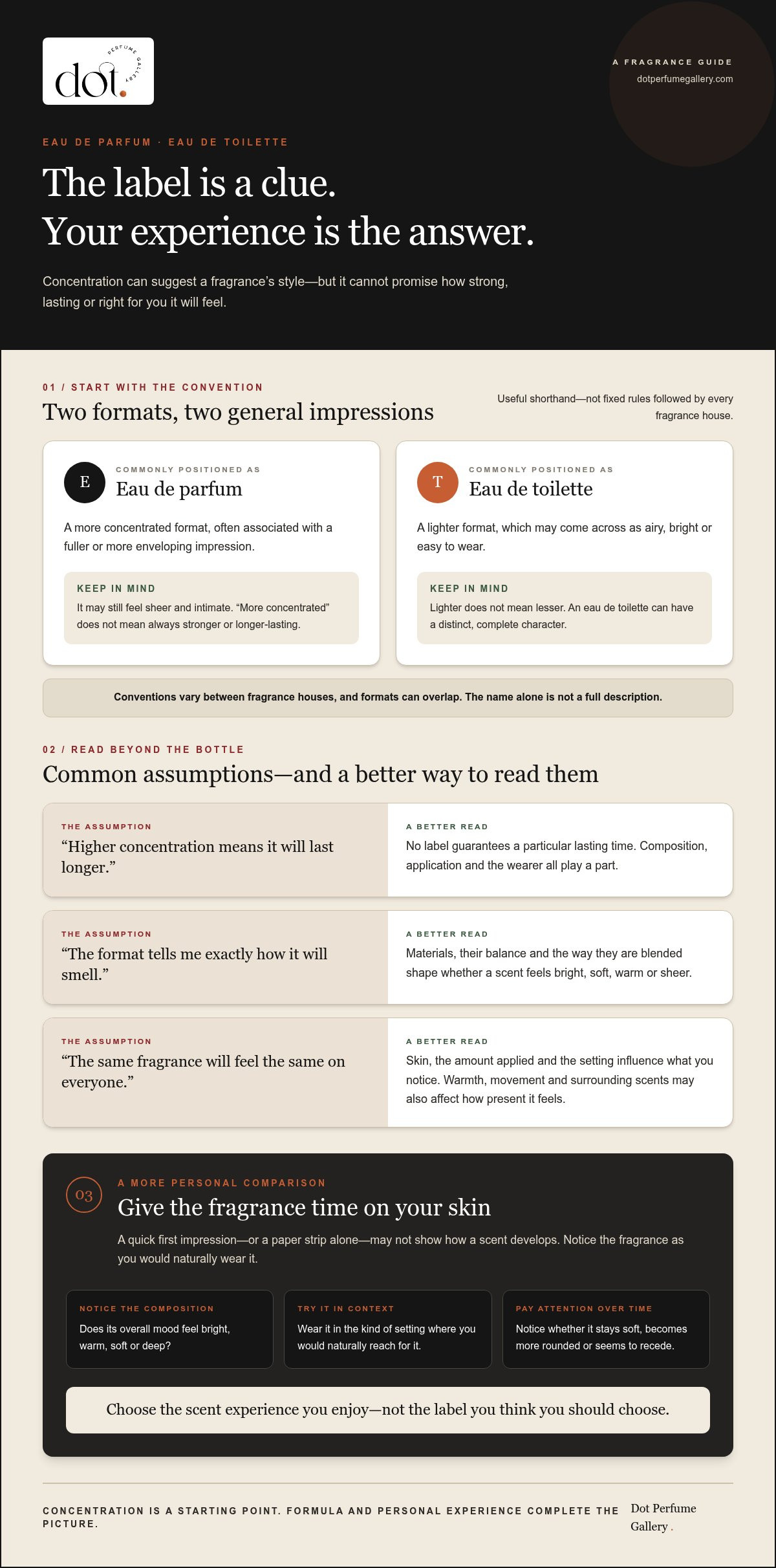
Both are fragrance formats, commonly distinguished by the proportion of fragrance concentrate and the character a fragrance house intends to create. Eau de parfum is usually positioned as the more concentrated style, whilst eau de toilette is usually presented as the lighter one. These are useful starting points, not promises about exactly how a scent will smell or wear.
The terms are part of a broader vocabulary for describing fragrance formats. Perfume concentrations are often used to classify them, but there isn’t one universal scale followed by every house. Conventions can vary between fragrance houses and individual formulations, so the label is a clue rather than a complete description.
In brief: eau de parfum is commonly a more concentrated fragrance format; eau de toilette is commonly a lighter one. Neither is inherently better. The right choice depends on the scent experience you enjoy.
What does eau de parfum mean?
Eau de parfum is commonly positioned as a more concentrated format. It may give a fragrance a fuller or more enveloping impression, but that depends on more than the label. The composition, the balance of its materials and your own perception all shape the experience.
“More concentrated” doesn’t mean “always stronger” or “always longer-lasting”. One eau de parfum may feel sheer and intimate, while another seems rich and noticeable. The wording describes a general convention, not a guaranteed level of projection or duration.
What does eau de toilette mean?
Eau de toilette is commonly positioned as a lighter fragrance format. It may feel airy, bright or easy to wear, but lighter doesn’t mean lesser: a carefully composed eau de toilette can have a distinct character and feel complete in its own right.
The name alone can’t tell you exactly how strong a scent will seem or how long it will last on your skin. A particular eau de toilette may feel more noticeable to you than an eau de parfum with a different composition. Judge the fragrance itself rather than assuming its label settles the question.
There’s no need to rank the two formats, with one automatically suited to special occasions and the other reserved for everyday wear. They describe fragrance styles, not rules for when to wear them. When comparing scents, notice the impression each creates: one might feel crisp and bright, another warm and soft. Your response can be a more useful guide than the wording on the bottle.
How Concentration, Formula and Skin Shape the Fragrance Experience
Concentration offers one clue to a fragrance’s character, but it isn’t the whole composition. The materials, their proportions and the way they’re blended influence whether a scent feels bright, velvety, warm or sheer. That’s why the difference between eau de parfum and eau de toilette can’t be understood through the label alone.
An eau de parfum label can’t promise a particular lasting time; composition, application and the wearer all play a part. For an overview of how these formats are commonly compared, see Eau de Parfum vs Eau de Toilette: A Comparison.
Why the fragrance formula matters as much as its label
A fragrance is built from materials and accords that combine to create its changing impression. Some combinations may feel sparkling and lifted; others may seem rounded, soft or warm. Two fragrances labelled eau de parfum can have very different personalities, just as two eau de toilettes can differ in mood and style.
The label doesn’t tell you which materials are used, how they’re balanced or how the scent may unfold from its first impression to its dry-down. A shared concentration label doesn’t make two compositions equivalent. One might feel delicate and close to the skin, while another makes a more noticeable impression. These qualities come from the formula, not simply the words on the bottle.
Why a fragrance may wear differently from person to person
The same fragrance can seem different from one wearer to another. Your skin, the amount applied and the setting influence what you notice, but they don’t provide a precise formula for predicting the result. Warmth, movement and surrounding scents may affect how present a fragrance feels, while your sense of smell can also change over the day.
Give a scent time on your skin rather than deciding from a quick first impression or a paper strip alone. Apply it as you normally would, then notice how it feels later: does it remain soft and intimate, become more rounded or seem to recede? This gives you a more personal sense of its character, though the experience may vary.
- Notice the composition: consider whether its overall mood feels bright, warm, soft or deep.
- Try it in context: wear it in the kind of setting where you’d naturally reach for it.
- Pay attention over time: observe how the scent develops without expecting the label to dictate the outcome.
Fragrance is personal: the bottle offers a beginning, while your skin and senses complete the picture. To explore different compositions side by side, browse the fragrance selection and notice which scents you enjoy wearing.
Eau de Parfum vs Eau de Toilette: A Comparison
Labels can offer a helpful first impression, but they aren’t a scorecard. Eau de parfum is commonly positioned as the more concentrated format, whilst eau de toilette is commonly positioned as lighter. These are general conventions, not fixed rules shared by every fragrance house. The formula matters just as much as the name.
Eau de parfum is commonly presented as more concentrated and eau de toilette as lighter, but neither label guarantees a particular intensity or lasting time. An eau de parfum isn’t automatically richer, better or longer-lasting. An eau de toilette can be expressive and distinctive, too. Use the comparison below as a guide to what you might prefer, not as a promise of how every fragrance will perform.
What the two formats can suggest, and what they cannot
The format may hint at a fragrance’s intended balance, but it can’t tell you exactly how it will feel on your skin. Houses may use different conventions, and formulations vary. A lighter eau de toilette might leave a vivid impression, while an eau de parfum may feel close and understated. The label doesn’t determine quality or guarantee that a scent will suit every wearer.
How to read an EDP and EDT comparison table
Read each row as a starting point for your own preferences. “Likely impression” describes a possible mood, not a guaranteed level of strength; “concentration convention” reflects common positioning, not a universal specification. If you want a soft presence or a more enveloping feel, use that preference to guide what you sample.
| Format | Concentration convention | Likely impression | What to consider |
|---|---|---|---|
| Eau de parfum (EDP) | Commonly positioned as the more concentrated format | May feel fuller, rounded or enveloping; varies by fragrance | Consider whether you enjoy a more present impression, then assess the specific scent on your skin. |
| Eau de toilette (EDT) | Commonly positioned as the lighter format | May feel airy, bright or easy to wear; varies by fragrance | Consider whether you prefer a lighter-feeling style, without assuming it will be faint or fleeting. |
Intensity and lasting time depend on the individual fragrance, not simply whether it is marked EDP or EDT. The materials, their balance, how much you apply and the conditions in which you wear it all influence the impression. A table can explain broad conventions, but it can’t replace experiencing the scent.
When weighing the difference between eau de parfum and eau de toilette, start with the atmosphere you want rather than a hierarchy of labels. Do you prefer a fine, airy layer or a scent that feels more enveloping? Your answer can narrow the field, while wearing a fragrance over time helps you decide whether it feels right on your skin.
How to Choose Between Eau de Parfum and Eau de Toilette
Let your own sense of comfort lead. The difference between eau de parfum and eau de toilette can help you decide where to begin, but your preferred mood, setting and way of wearing fragrance matter more than rules about which format belongs at a particular time of day or year. Use these steps to guide your choice.
- Picture the impression you want. Are you drawn to something delicate and close, or would you enjoy a more enveloping presence? You might want a bright, airy feeling one day and a warmer, more noticeable one another. These are preferences to explore, not qualities guaranteed by a label.
- Consider where you’ll wear it. Think about your usual surroundings and how you like fragrance to sit around you. A softly sensed scent may feel comfortable in close company; a more noticeable one might suit a setting where you’d like its presence to be part of your expression. Neither format is restricted to work, evenings or special occasions.
- Choose for personal comfort. If a fragrance feels too present, applying less may create a gentler impression. If you enjoy a more enveloping feel, you might prefer a different composition or format. The best choice is one you enjoy wearing.
- Sample before deciding. Smell a fragrance on a blotter to notice your first response. If you’re curious, try it on your skin and give it time to unfold before forming a view.
Start with the feeling and presence you want
Imagine the sensation you’d like to carry with you: a fine, sheer layer, a clear presence, a soft warmth or a scent that stays close. This can guide your sampling more usefully than choosing by format alone. Application matters, too. Start lightly and notice how comfortable the fragrance feels in your surroundings. Don’t assume you need more because it’s an eau de toilette, or less because it’s an eau de parfum.
Sample thoughtfully before deciding
A blotter offers a first glimpse, whilst your skin gives you a more personal impression. Try one fragrance at a time if you can; comparing several at once may make their individual qualities harder to distinguish. Notice the opening, then return to the scent later to see whether its developing character still appeals. A fragrance that charms you at first sniff may feel different once it has settled, so give that later impression space in your decision.
Take your time. A favourite might suit crisp mornings as readily as quiet evenings, whatever its label. Browse the fragrance selection and explore which scents feel at ease on your skin and in your everyday life.
Explore Eau de Parfum and Eau de Toilette
The most useful answer to the comparison isn’t a winning label, but a clearer sense of what you enjoy wearing. Concentration can offer a starting point; the fragrance’s character, how it sits on your skin and the mood it creates make the choice personal. Whether you’re drawn to eau de parfum or eau de toilette, neither format signals greater sophistication or quality.
Exploring different fragrance houses and scent families can help you recognise the styles you’re drawn to. You might like bright green freshness, soft florals or warm, resinous notes. Sampling beyond your usual preference can be revealing, too: a scent family you haven’t considered might feel unexpectedly familiar on your skin. Over time, you’ll notice the textures and moods you return to, making the label a smaller part of the decision.
Dot Perfume Gallery is an independent retailer of niche, luxury and British fragrances, with a considered selection from houses including Floris, Flâner, Angela Flanders and Jorum Studio. Exploring different makers can give you a broader perspective than comparing formats in isolation. Two fragrances with the same label may have entirely different characters; a house’s approach to materials and composition can be as interesting as whether a scent is EDP or EDT.
Let your own preferences lead the choice
Notice what feels most natural: a delicate, close-wearing presence, a scent that gently fills the space around you or something in between. Your preference may shift with your mood or setting, and that’s part of the pleasure. You don’t need to choose one format for every occasion or treat one as more refined. Let comfort, curiosity and personal taste guide you.
When a personal fragrance consultation can help
If you’re unsure where to begin, a guided conversation can help you put your preferences into words. You might discuss the notes and textures you’re drawn to, the fragrances you already enjoy or questions that arise as you compare formats. A private perfume consultation offers a thoughtful way to explore those ideas and discover which scents feel most like you.
Private perfume consultations are available by appointment on Tuesday to Thursday evenings. Or take a quieter first step and explore the selection at your own pace. Explore the curated fragrance selection and notice which fragrances invite you to pause and experience them again.
Let Your Next Fragrance Find You
Choosing a scent needn’t be a test you pass. Notice which fragrance makes you pause, what memories or moods it stirs and whether you feel at ease wearing it. The difference between eau de parfum and eau de toilette can help you begin exploring, but the most meaningful discovery is the scent that feels like your own.
Give yourself room to be surprised. A fragrance you might have passed over by name could feel beautiful when you experience it slowly, while a familiar style may reveal a new dimension on your skin. Follow the details that draw you in, whether they feel luminous, soft, green or warmly textured. Your preferences don’t need to fit a single label, season or occasion.
Dot Perfume Gallery offers a considered place to continue that discovery. Explore the curated fragrance selection and take your time finding a scent that feels at home with you. Let the choice be personal, unhurried and entirely your own.
Frequently Asked Questions
Is eau de parfum better quality than eau de toilette?
No, the format alone doesn’t determine quality. The difference between eau de parfum and eau de toilette is not a ranking: both can be thoughtfully composed, and either may suit your taste. Consider how the fragrance smells to you, how it develops and whether you enjoy wearing it. A higher concentration label isn’t proof that a scent is more refined, more complex or better made.
Can you layer eau de parfum with eau de toilette?
Yes, you can layer them, though the result depends on how the fragrances combine. If they share a scent style, such as fresh citrus or soft woods, they may sit comfortably together; contrasting notes can create a more unexpected blend. Try a small amount of each on separate blotters first, then test the pairing on skin. Start with one spray of each at most, and adjust only if you like the effect.
What happens if I wear eau de parfum in warm weather?
You can wear eau de parfum in warm weather, but heat may make a fragrance feel more noticeable or diffuse differently. If it seems too present, try applying less and wearing it in a well-ventilated setting. You might also test it on a cooler day before deciding how it suits you. There’s no need to reserve a format for a particular season; your comfort and the fragrance itself are better guides.
How much eau de parfum or eau de toilette should I apply?
Start with a light application, then see how the fragrance feels before adding more. One spray is a useful cautious starting point, not a universal rule; the sprayer, formula and setting all make a difference. Follow the product’s directions, and be considerate in close or shared spaces. If you’re unsure, apply less at first. It’s easier to add a little later than to soften a fragrance that feels overpowering.
Can fragrance concentration cause skin irritation?
Fragrance can irritate or trigger a reaction in some people, and the concentration label alone can’t predict whether you’ll be affected. If your skin is sensitive, avoid applying fragrance to irritated or broken skin and consider testing a small area first. Stop using it if you notice discomfort, redness or itching. For a severe or persistent reaction, wash the area and seek advice from a healthcare professional.
How should I store eau de parfum and eau de toilette?
Keep both formats in a cool, dry place away from direct sunlight and sudden temperature changes. A bedroom drawer or cupboard is generally more suitable than a sunny windowsill or a steamy bathroom. Close the cap firmly after use, and keep the bottle in its original box if you’d like extra protection from light. These habits help limit exposure to conditions that can alter a fragrance over time.