

How to Buy Perfume Without Testing: A Thoughtful Guide
What if choosing a fragrance without smelling it first isn’t a gamble, but a decision shaped by several useful clues? If you’re wondering how to buy perfume without testing, the hesitation is understandable: a beautifully written description can still leave you unsure how a scent will feel on your skin.
A perfume’s notes and mood can suggest a familiar direction, but they can’t promise exactly how it will develop or whether you’ll enjoy wearing it. A more useful approach is to weigh several clues together instead of relying on one poetic phrase or choosing by name alone.
This guide will help you read fragrance descriptions, identify the details that are informative and build a shortlist around scents and moods you already enjoy. We’ll consider fragrance families, notes, concentration and wearer reviews, while keeping their limitations in view. Dot Perfume Gallery brings together niche, luxury and British fragrances from several houses, with browsing organised by perfume house and fragrance family. For a more personal conversation, private perfume consultations offer another way to explore your preferences. With realistic expectations and a little discernment, your choice can feel less like a leap and more like an invitation.
Key Takeaways
- Begin with fragrances you already enjoy, and identify the qualities that make them comfortable to wear.
- Read notes and descriptions as clues to a fragrance’s character, not an exact preview of how it will develop.
- Compare the description, fragrance-house context and wearer reviews. No single clue can promise a perfect match.
- Use a simple checklist before buying, including the exact fragrance name, concentration and bottle size.
- For how to buy perfume without testing, a considered shortlist and browsing by fragrance family or house can help you choose with greater confidence.
How to buy perfume without testing starts with knowing what you enjoy
Scent is personal: the same fragrance can feel airy and comforting to one person, but dense or distracting to another. An online description can suggest a mood, but it can’t reproduce how a perfume changes as you wear it. That’s why how to buy perfume without testing begins with your own experience, not a search for a supposedly universal “safe” choice.
Think about the perfumes you already reach for. Which feel easy to wear on an ordinary morning? Which stay in your memory, and which do you enjoy only in a particular place or moment? You don’t need specialist perfumery vocabulary. Words such as soft, crisp, powdery, warm, green or bold can be more useful than a long list of ingredients if they describe how a scent feels to you.
Our sense of smell is shaped by how we perceive and interpret odours; the science of olfaction offers useful context for why scent is such a personal experience. A fragrance description can give you clues, but it can’t tell you exactly what you’ll feel when you wear it.
Use familiar fragrances as personal reference points
Make a short note of a few fragrances you know well, then describe your response in everyday language. Perhaps one feels like clean linen, another like a warm room, and a third is memorable but too intense for daily wear. Separate the perfume from the associations around it: a scent may feel lovely because it reminds you of a celebration, even if you wouldn’t choose that character for a quiet day.
Notice the qualities behind your reaction. Does the fragrance feel smooth or sparkling, cosy or airy? Does it stay close to you, or make a stronger impression in the room? These observations turn vague likes and dislikes into reference points you can compare with descriptions later.
Match the perfume to the life you want it to accompany
Picture where you’d like to wear a new scent: at your desk, on a weekend walk, at dinner, or during a moment that feels entirely your own. Consider the atmosphere you’re seeking as well as the setting. You might want something unobtrusive and reassuring for everyday routines, or a more noticeable presence for occasions when you feel like making an impression. Neither is better. The right brief is personal, not dictated by age or gender.
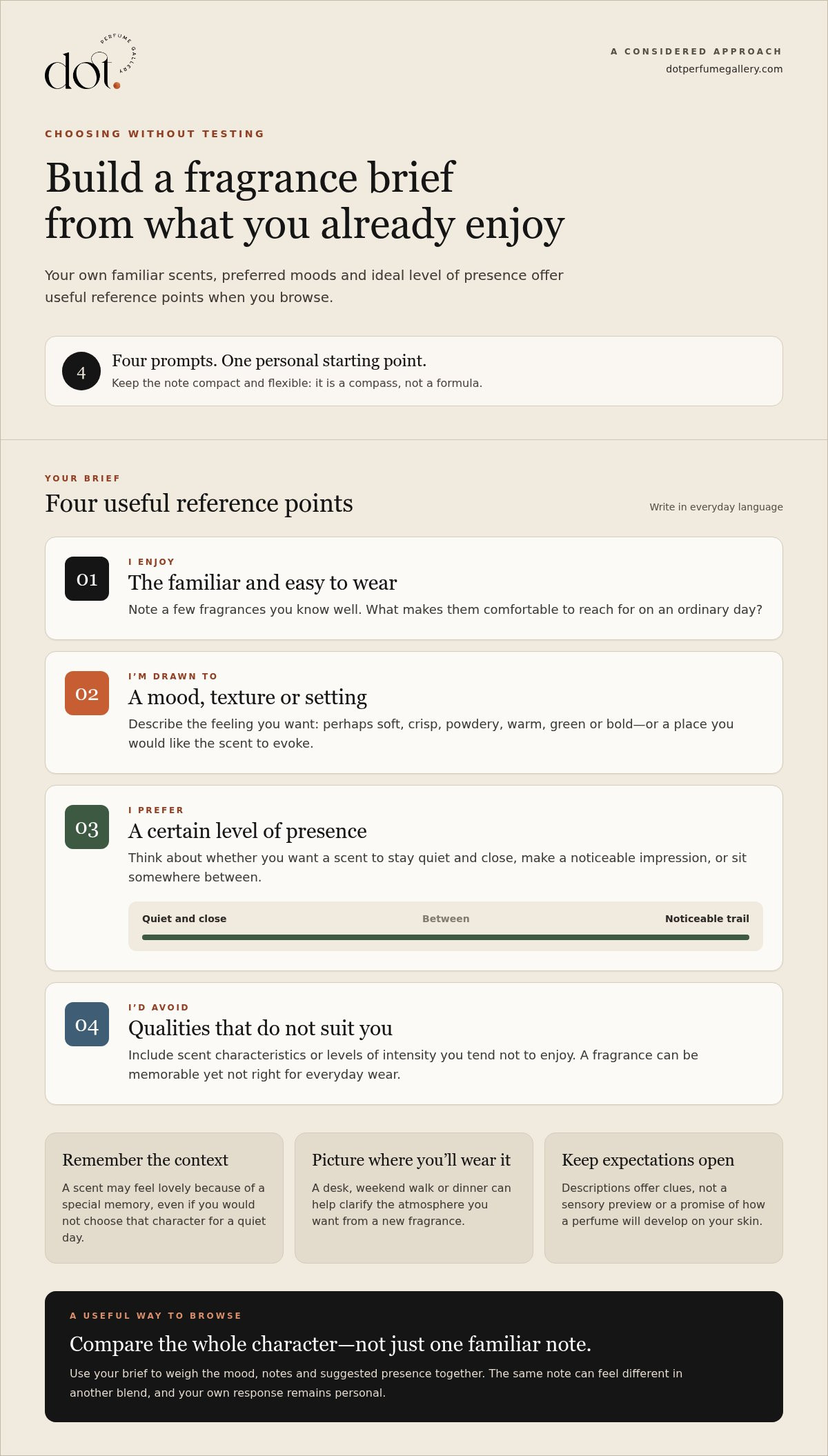
Gather your preferences into a compact note to keep beside you while browsing:
- I enjoy: familiar scents or qualities that feel easy to wear.
- I’m drawn to: moods, textures or settings I’d like a fragrance to evoke.
- I prefer: a quiet presence, a noticeable trail, or something between the two.
- I’d avoid: qualities or levels of intensity I tend not to enjoy.
Keep the brief flexible. It’s a compass, not a formula, and gives you a personal starting point for weighing the clues in a fragrance description.
How to read perfume notes and descriptions before buying
A fragrance description is best read as a collection of clues, not a precise preview of how the perfume will smell on your skin. Notes can hint at its direction, mood and materials, but the finished composition may feel more layered than the list suggests. If you’re learning how to buy perfume without testing, look for a pattern across the whole description rather than treating one familiar word as a promise.
Read listed notes as clues, not a recipe
A note list can help you recognise impressions you enjoy, but it isn’t a simple formula in which each ingredient has one fixed effect. A familiar note might be softened, brightened or deepened by the materials around it. Read the surrounding description too: does it suggest freshness, warmth, softness or a more pronounced presence?
For instance, seeing rose may catch your eye, but the rest of the description can help you picture the broader character. Is the rose presented as airy and green, or set within a warmer, richer mood? The note offers a starting point, not a guarantee that the fragrance will resemble another rose perfume you’ve worn.
Descriptions can also use notes to evoke an impression rather than provide a literal inventory. A phrase such as “a mineral freshness” helps convey an atmosphere, but it doesn’t tell you exactly what you’ll smell. Consider both kinds of language: the recognisable note and the feeling the writer uses it to suggest.
Translate evocative fragrance language into practical questions
Words such as soft, bright and warm are open to interpretation. Ask what each means to you. Does “soft” suggest a gentle scent that stays close, or a powdery texture? Does “bright” sound sparkling and lively, or sharp? “Warm” might feel cosy to one reader and rich to another. Your own associations matter more than a universal definition.
Compare those impressions with your preference brief. If you’re seeking a quiet everyday fragrance, repeated suggestions of boldness or a strong presence may be less aligned, even if one listed note is a favourite. Conversely, language about a calm, close-wearing mood may fit what you want, though it can’t confirm how the perfume will behave on you.
Descriptions are clues, not sensory substitutes. They combine selected notes, creative language and an interpretation of the composition, without reproducing its full development on your skin. The same note can feel different in another blend, and a wearer’s experience may vary with skin and setting. Let the copy shape a sensible expectation, not a certainty.
As you browse, underline the words that match your preferences and pause over those that don’t. Dot Perfume Gallery’s browsing by fragrance house and family gives you a considered way to compare descriptions and follow the language that resonates with you. Explore fragrances by house and family as you refine your shortlist.
Which clues can you trust when choosing perfume without testing?
No online clue can guarantee that a fragrance will feel right once you wear it. The aim is not certainty, but a more considered choice: gather different kinds of information, notice where they agree, and be honest about what remains unknown. That is the heart of how to buy perfume without testing: trust a pattern of clues more than one persuasive phrase or a glowing rating.
Each source answers a different question. Product details help identify exactly what is being sold; notes and descriptions suggest a sensory direction; a fragrance house can offer broader context; and reviews reveal how particular wearers responded. None can stand in for your own experience. Their usefulness depends on what you’re trying to find out.
| Clue | What it can suggest | What it can’t establish |
|---|---|---|
| Product description | The intended mood, character or setting of the fragrance. | Exactly how it will smell to you or develop on your skin. |
| Listed notes | Recognisable materials or impressions that may point towards a familiar direction. | That a familiar note will create a familiar overall effect. |
| Fragrance-house context | A broader sense of the house’s creative point of view, where that information is available. | That every fragrance from the house shares the same character. |
| Wearer reviews | Individual reactions and impressions that may reveal recurring themes. | A universal outcome or a reliable prediction of your own experience. |
| Product details | The exact fragrance identity and the stated concentration or bottle size. | Whether you’ll enjoy its scent. |
Separate useful product information from subjective opinion
Start by distinguishing what can be checked from what is someone’s interpretation. A fragrance name, stated concentration and bottle size are product details; words such as “captivating” or “comforting” describe an impression. Reviews belong in the second category, even when they’re sincere. Look for recurring observations across different reviewers, but treat a star rating or one vivid testimonial as a reaction, not proof that the perfume will suit you.
Recognise when uncertainty is still too high
Pause if the overall description conflicts with your preference brief. One appealing note may not outweigh repeated language suggesting an intensity or mood you usually avoid. Equally, unfamiliar wording needn’t rule out a fragrance if other clues feel aligned. Weigh the evidence as a whole, remembering that research can reduce uncertainty but can’t remove it.
A useful final check is to ask whether the clues converge. If the description, broader context and several reviews point towards qualities you want, you have a more grounded reason to consider the perfume. If they pull in different directions, keep it on a tentative shortlist rather than treating a compelling phrase as a promise. Confidence comes from knowing both what the evidence supports and where it falls silent.
A practical checklist for buying perfume without testing
A short pause before purchase can turn a tempting choice into a considered one. If you’re deciding how to buy perfume without testing, follow a consistent sequence rather than letting a striking phrase, trend or attractive bottle decide for you. The aim is to check whether the fragrance seems aligned with what you enjoy, while staying clear-eyed about what you can’t know until you wear it.
Follow a five-step pre-purchase checklist
Keep the process simple. Start with your own preferences, weigh the available clues, then check the practical details before deciding:
- Return to your preference brief. Start with the moods, settings and intensity you want, not what happens to be fashionable or described in the most alluring terms.
- Read the full description. Notice the overall character and intended atmosphere instead of focusing on one appealing adjective.
- Compare the notes. Ask whether the listed notes suggest a direction you might enjoy, and whether the full composition sounds consistent with your brief.
- Weigh the other clues. Consider fragrance-house context and recurring impressions in wearer reviews as perspectives, not promises.
- Check the product details. Confirm the exact fragrance name, concentration and bottle size, so you know precisely what you’re choosing.
Before you commit, read your brief once more. If the fragrance still seems suited to the way you want to wear it, you have a reasoned basis for your choice. If the description clashes with a preference that matters to you, let the decision rest. Enthusiasm shouldn’t have to drown out your own judgement.
Give the first wear room to unfold
Once your perfume arrives, approach the first wear as an observation, not a verdict. Apply it as directed, and avoid using more in an effort to make the scent easier to judge. Notice your first impression, then give the fragrance time to evolve before deciding what you think.
A few quiet notes can help: how does it feel at first? Does it remain comfortable, and does its presence suit the setting you had in mind? You might find that the opening is brighter or more pronounced than expected, while the later impression feels softer. Record what you notice without expecting your experience to match a reviewer’s exactly.
One brief encounter may not tell you everything. Give yourself room to notice how you feel wearing the perfume through the day, without forcing yourself to like it or dismissing it at once. A calm first wear is a more useful guide than over-applying, checking repeatedly or making a final judgement from the opening alone.
For a more individual way to reflect on your preferences before choosing, book a private perfume consultation.
Explore a considered perfume choice with Dot Perfume Gallery
A thoughtful choice needn’t begin with a confident prediction. At Dot Perfume Gallery, an independent destination for niche, luxury and British fragrances, you can explore a curated selection through the details that matter to you: a house’s point of view, a fragrance family, or the mood you hope a perfume will accompany. Treat each description as an invitation to consider, not a promise of precisely how the scent will feel.
Use curated fragrance houses as a starting point
Browsing by fragrance house can help you explore perfumes in more depth, while browsing by family offers another way to notice shared themes and contrasts. Dot Perfume Gallery brings together fragrances from Flâner, Floris, Angela Flanders and Jorum Studio. Keep your preference brief close by as you read, and look for language that resonates with your own idea of comfort, atmosphere and intensity.
Let curiosity lead, but give each clue room to speak. A house name may offer useful context, while the description and listed notes can help you imagine a fragrance’s direction. Compare these impressions with what you already know you enjoy. Don’t assume every fragrance from one house will feel alike, or that a familiar note ensures a familiar experience. The aim is to find considered possibilities, not a guaranteed match.
You might begin with the atmosphere you want, then browse a fragrance family for descriptions that seem to fit. Or you may be drawn to a particular house and compare how its fragrances are described, noticing which language aligns with your preferences and which suggests a different direction. Moving between these routes makes browsing more purposeful without narrowing your curiosity too soon.
When a personal conversation may help
If you’d value a more individual conversation, private perfume consultations are available by appointment on Tuesday to Thursday evenings. You can discuss the qualities you’re drawn to, the settings you have in mind and the impressions you tend to avoid. Sharing those preferences gives you a way to explore possible directions with thoughtful guidance, while leaving space for the personal nature of scent.
Bring your notes or preference brief into the conversation. Even a few simple words, such as “soft”, “bright” or “quiet”, can give you a useful place to begin. You don’t need specialist vocabulary; the most helpful starting point is an honest account of what feels wearable to you and what kind of presence you’re hoping for.
Buying without testing will always leave some uncertainty, but a considered browse can make the choice feel more grounded. Explore Dot Perfume Gallery and discover a fragrance journey shaped by personal preference, careful attention and the pleasure of finding a scent that feels worth imagining.
Let your next fragrance choice begin with curiosity
Choosing a perfume unseen will always leave a little room for surprise. That needn’t make the decision careless. Think of how to buy perfume without testing as an invitation to choose with curiosity: follow the details that speak to you, trust your own preferences, and leave space for the scent to become its own experience.
Your next step could be to browse slowly, without expecting an instant answer. Notice which descriptions draw you in, which moods feel right, and what you’d like a fragrance to accompany. If you’d welcome a more personal perspective, a private consultation can offer a considered space to talk through the qualities you’re seeking.
Explore a considered selection of niche and luxury fragrances, and let a promising description become the beginning of a more personal discovery. You don’t need complete certainty to choose thoughtfully; you only need a sense of what feels worth exploring.
Frequently Asked Questions
Can you really choose a perfume without smelling it first?
Yes, you can make a thoughtful choice, though you can’t know with certainty how a fragrance will feel once worn. If you usually enjoy light, unobtrusive scents, for example, a description emphasising a bold, enveloping presence may not fit your everyday preferences. For how to buy perfume without testing, treat online information as a way to decide whether a fragrance is worth considering, not a promise of how you’ll experience it.
Is buying perfume online without testing it a bad idea?
Not necessarily, but it involves more uncertainty than smelling a fragrance before choosing. Consider how much you already know about the style being described and whether the fragrance seems suited to the way you intend to wear it. Check that the product page identifies the exact perfume you mean, especially if similar names appear together. If you’re still unsure, waiting is a perfectly sensible choice.
How much should you rely on perfume reviews before buying?
Use reviews as individual accounts, not predictions of your own experience. A useful review might explain that a fragrance felt too strong for an office or particularly comforting on a cold evening; those details reveal context as well as preference. Look for similar observations from different people, then compare them with the product description. A high rating alone can’t tell you whether the scent suits your tastes.
Can the same perfume smell different on different people?
Yes, people can experience the same perfume differently. Skin and application may influence how it develops, while surroundings and personal associations can shape what someone notices. For example, a reviewer may describe a fragrance as sweet because of a particular memory, while you might focus on its fresh or woody impression. Treat another wearer’s account as a perspective, rather than expecting an identical result.
Does perfume concentration tell you exactly how a fragrance will smell?
No. Concentration is useful product information, but it doesn’t reveal the scent’s full character or tell you exactly how you’ll perceive it. Two fragrances with the same concentration can still have very different moods and compositions. Read the label alongside the description, and check it matches the version you intend to buy. Don’t use concentration alone as a shortcut for deciding whether you’ll enjoy the perfume.
Should you buy a perfume as a gift without testing it?
You can, especially if you know what the recipient already enjoys wearing. Notice whether they tend to choose crisp, delicate scents or richer, more noticeable ones, and consider when they wear fragrance. If their preferences are unknown, a perfume can be a personal guess. Dot Perfume Gallery also offers gifts, which may give you another thoughtful way to mark the occasion without trying to predict their ideal scent.