

Long-Lasting Niche Perfume: What Makes a Fragrance Linger?
What makes a long lasting niche perfume feel right to wear? It may not be the fragrance that announces itself across a room. It could be the one that stays quietly close to you, changing as the day goes on. A scent can seem to vanish within an hour, even when its label suggests a richer concentration; another may leave a soft trace on a scarf after its opening has faded.
It’s tempting to look for a simple answer in terms such as Eau de Parfum or extrait, or to assume that powerful projection means better staying power. But longevity, projection and sillage describe different aspects of a fragrance’s presence. None tells the whole story on its own.
This guide explains what shapes a perfume’s wear over time, from its composition and concentration to your skin and surroundings. You’ll learn how to assess a scent on your own skin, tell a close-wearing dry-down from a fragrance that has truly disappeared, and decide what kind of presence suits your day. At Dot Perfume Gallery, private consultations offer a thoughtful setting to discuss the scents you’re drawn to and the performance you hope to find.
Key Takeaways
- Longevity, projection and sillage describe different aspects of a fragrance’s presence. Decide which matters most to you.
- Composition can influence how a long lasting niche perfume develops, but deeper materials don’t guarantee a particular wear time.
- Niche status and concentration labels alone can’t predict how a scent will perform on your skin.
- Apply a fragrance as directed, then notice its opening, development and remaining skin scent over time.
- Consider the scent character and presence you enjoy. A private consultation can help you explore your preferences and expectations.
What does long-lasting niche perfume actually mean?
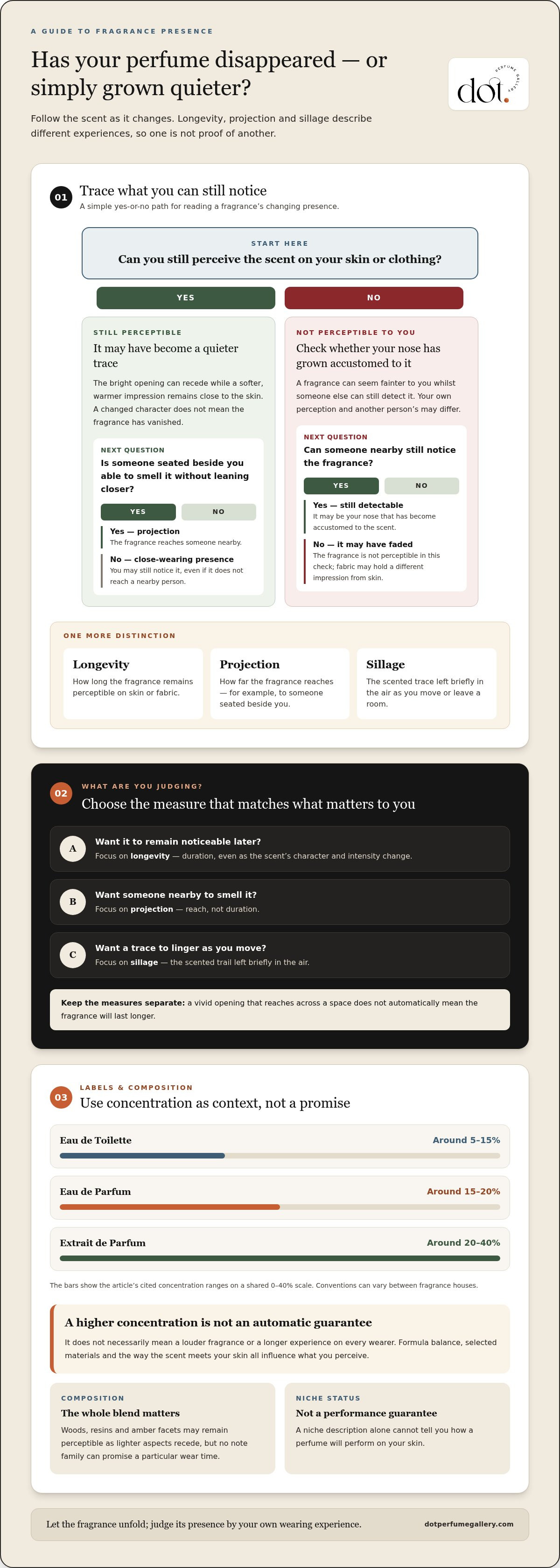
Longevity is the length of time a fragrance remains perceptible on your skin or clothing. It doesn’t mean the scent will stay equally vivid from its first bright, lifted moments to its softer dry-down. A fragrance may become a quiet trace rather than disappear altogether. How long you notice it can also differ from how long someone nearby can smell it.
Fragrance longevity is the period during which you can still perceive a scent on skin or fabric, even as its character and intensity change. This is a more useful starting point than expecting every perfume to perform in the same way. The language of the science of perfume can help explain how a composition unfolds, but your own experience is what gives its staying power meaning.
Longevity, projection and sillage: three different experiences
Think of longevity as duration, projection as reach, and sillage as the scented trail left as you move. They can overlap, but one isn’t proof of another.
- Longevity: A scent remains noticeable on your wrist later in the day.
- Projection: Someone seated beside you can smell it without leaning closer.
- Sillage: A delicate trace lingers briefly in the air after you leave a room.
A close-to-skin fragrance may remain perceptible for a long while without filling a room. In the same way, a vivid opening that reaches across a space doesn’t automatically mean the scent will last longer. Strong projection describes distance, not duration.
Why “long-lasting” can mean different things to different people
One person may want a scent that stays softly present through an afternoon; another may prefer to notice it only when bringing a wrist close. Sensitivity matters, too. Your nose can grow accustomed to a fragrance, making it seem fainter even while someone else can still detect it.
Surroundings also shape perception. Warmth, movement, fresh air and other scented environments can affect how clearly you notice a perfume. Fabric may hold a different impression from skin. For these reasons, it’s more useful to treat longevity as a personal wearing experience than as a fixed promise.
Notice the difference between a fragrance becoming subtler and vanishing entirely. Its sparkling opening may recede, leaving a softer, warmer impression close to the skin. If you’re considering a long lasting niche perfume, give that quieter phase time to unfold instead of judging it by the first burst or the label alone.
There’s no single ideal level of presence. What matters is whether the fragrance’s changing character suits your day, your surroundings and the way you like to wear scent.
How fragrance composition shapes a niche perfume’s staying power
A fragrance doesn’t unfold as one unchanging impression. Its character shifts: a bright first impression softens, a more rounded heart emerges, and the final impression settles close to the skin. The familiar language of top, heart and base notes helps describe this movement. Real perfumes, however, are blended compositions rather than a rigid sequence of separate layers.
Longevity reflects the whole composition, not one note in isolation. Materials often described as deeper or weightier, such as woods, resins and amber facets, may remain perceptible as lighter, more fleeting aspects recede. But a note family is only one part of the blend. It can’t promise how long a finished perfume will wear.
What the fragrance pyramid can, and cannot, tell you
Top notes are the facets you may notice first; heart notes give the fragrance much of its unfolding character, while base notes help shape its later impression. Think of this as a map, not a timetable. A fresh opening may grow quieter, allowing warmer or softer facets to come forward. Note descriptions can guide you towards a scent’s character, but not guarantee its wear time.
That’s why two perfumes with a note in common can behave quite differently. The note’s role, the materials around it and the balance of the blend all matter. A woody impression might feel dry and airy in one composition, then smooth and enveloping in another. If you’re drawn to the warmth associated with amber, an amber niche perfumes guide can help you explore the family’s character without treating it as a performance promise.
Concentration is a clue, not a promise
Labels such as Eau de Toilette, Eau de Parfum and Extrait de Parfum generally indicate the proportion of aromatic materials in a fragrance. Commonly cited ranges are around 5-15% for Eau de Toilette, 15-20% for Eau de Parfum and 20-40% for Extrait de Parfum, although conventions can vary between houses. These labels offer context, not a reliable ranking of how long every scent will last.
A higher concentration doesn’t automatically mean a louder fragrance or a longer experience on every wearer. The formula’s balance, the materials selected and the way a scent meets your skin all influence what you perceive. If you’re searching for a long lasting niche perfume, treat concentration as one clue among several, then consider the composition and how it develops on you.
If you’d like to discuss fragrance character and performance expectations, Dot Perfume Gallery offers private perfume consultations by appointment on Tuesday to Thursday evenings. A consultation gives you a personal setting to reflect on the scents you enjoy and the presence you’re hoping to find.
Does niche perfume always last longer? The performance misconception
No. A perfume doesn’t last longer simply because it’s described as niche. “Niche” refers to a category or approach to perfumery, not a measured level of staying power. Niche and designer fragrances can each vary in character, intensity and development. The label alone can’t tell you how one particular scent will wear.
To assess performance more thoughtfully, separate four influences: the fragrance category, its concentration, its composition and your own wearing experience. Each offers a different clue, but none settles the question on its own.
| Factor | What it can suggest | What it can’t prove |
|---|---|---|
| Category | Whether a fragrance is presented as niche or designer. | How long it will remain perceptible. |
| Concentration | The general proportion of aromatic materials. | That it will last longer or project further on you. |
| Composition | The kinds of facets and materials shaping its character. | A guaranteed wear time based on one note or family. |
| Personal wear | How the fragrance comes across in your own setting. | How everyone else will experience it. |
Niche versus designer: what the label tells you
Niche perfumery often allows room for distinctive creative expression, but that doesn’t make the category a longevity rating. One niche fragrance may feel soft and intimate; another may have a more noticeable presence. Designer scents are just as varied. The considered guide to Andevalo perfume offers a way to explore scent character without treating category as proof of performance.
Think of the label as context, not a verdict. It may tell you something about a house’s creative approach, but the individual composition is what you’ll actually experience on your skin.
Why concentration and price cannot settle the question
A higher concentration may suggest a greater proportion of aromatic materials, but it doesn’t automatically mean a scent will last longer for every wearer. Nor does luxury positioning guarantee a particular result. Formula, application and your own perception all contribute to the way a perfume unfolds. Even two fragrances at the same concentration can feel quite different.
If you’re searching for a long lasting niche perfume, let curiosity lead rather than assumptions. Explore the fragrance itself: how its character develops, how close or noticeable you’d like it to feel, and whether its wear suits your routine. Dot Perfume Gallery’s private perfume consultations, available by appointment on Tuesday to Thursday evenings, offer a personal setting to discuss scent preferences and performance expectations. Explore private perfume consultations as part of your discovery.
How to assess a long-lasting niche perfume on your own skin
A thoughtful wear test is less like an examination and more like giving a fragrance time to tell its story. Rather than deciding from the first spray, observe how it changes through an ordinary day and whether its presence suits the way you want to wear it.
A personal wear log can reveal more than a quick first impression. A few simple notes help you compare what you actually notice, without relying on memory or a bold claim on a label.
A simple fragrance wear test, from first spray to dry-down
Choose one fragrance and follow its application guidance. Note the time, where you applied it and the setting, then resist the urge to keep sniffing your skin. Check in at natural moments instead. This gives you a little distance and helps you notice the transition from opening to later development.
- At application: Record the time and your first impression, such as bright, soft or warm.
- As the day unfolds: Notice whether its character changes and when you become aware of it again.
- Later on: Check whether you can still perceive a trace on the same area of skin, even if it has become subtle.
Keep the amount applied and the setting as consistent as practical when comparing fragrances. Repeat the observation on different days before drawing a conclusion. One wear may be shaped by an unusually warm commute, a busy day or a change in routine.
Skin, surroundings and olfactory fatigue
Your skin’s condition, the temperature around you and your level of activity can all influence the wearing experience. So can olfactory fatigue, when you become less aware of a scent after smelling it for a while. If it seems to have vanished, pause before applying more. You may simply have stopped noticing it as readily.
A trusted person can offer another perspective on whether a fragrance is still perceptible, but their impression isn’t definitive. They may be more or less sensitive to it than you, and the scent may reach them differently from how it feels close to your skin.
Use your notes to separate changes in the perfume from changes in your attention or surroundings. If a fragrance feels quieter later, record that honestly rather than treating subtlety as failure. Over several wears, you’ll build a more personal picture of its character, presence and suitability for your day.
For a considered conversation about the scents you enjoy and the performance you’re looking for, explore private perfume consultations at Dot Perfume Gallery, available by appointment on Tuesday to Thursday evenings.
Finding a niche perfume whose lasting presence feels like you
Choosing a fragrance isn’t simply a search for the longest possible wear. It’s about finding a character you enjoy, with a presence that feels comfortable in the places and moments you want to wear it. A scent that feels beautifully close during a quiet evening may not suit someone seeking a more noticeable impression throughout a busy day.
Before browsing, imagine how you want perfume to accompany you. Should it feel like a soft, private detail, something a nearby friend might notice, or a more distinctive presence? There’s no right answer. Your preference may shift with the season, occasion or mood.
Describe the presence you enjoy, not just the hours you want
Think about where you’ll wear a fragrance: at work, on a journey, at home or for an evening out. Consider whether you’d like to catch its scent occasionally yourself, share it with those nearby, or leave a more noticeable impression. These preferences describe the kind of presence you enjoy, not a promise about how long a perfume will last.
Then consider its character separately. You might be drawn to something airy, richly textured, comforting or quietly luminous. Keeping character and performance expectations distinct makes it easier to explore with an open mind, rather than ruling out a scent because its label or category seems to promise a particular result.
Explore niche fragrance with a thoughtful guide
Dot Perfume Gallery curates niche, luxury and British fragrances from a range of perfume houses. A private consultation gives you space to discuss the scents you’re drawn to, where you hope to wear them and what kind of presence feels right. It’s a conversation about preferences and possible fragrance directions, not a guarantee that a scent will perform in a particular way.
A few impressions can help make that conversation more personal. Describe fragrances you’ve enjoyed, the settings you have in mind, or whether you tend to prefer a scent that stays close or feels more noticeable. You don’t need specialist vocabulary; simple descriptions of mood, texture and desired presence are a thoughtful place to begin.
A long lasting niche perfume isn’t just one that remains perceptible for a long time. It’s a fragrance whose changing presence feels pleasing and appropriate to you. Let your preferences guide the search, then give each scent room to reveal its character.
Explore niche fragrances at Dot Perfume Gallery, or consider a private perfume consultation, available by appointment on Tuesday to Thursday evenings, to explore your scent preferences and performance expectations.
Let your next fragrance feel like a discovery
Choosing a long lasting niche perfume needn’t mean searching for the loudest or most enduring scent. Let yourself be guided by the impression you want to carry: a gentle veil for familiar routines, a more vivid presence for an occasion, or something that feels entirely your own. The right choice is personal, and you can discover it one thoughtful encounter at a time.
As an independent perfume gallery, Dot Perfume Gallery brings together niche, luxury and British fragrances. If you’d value a personal conversation, private perfume consultations are available by appointment on Tuesday to Thursday evenings. They offer space to discuss your preferences and what you hope a fragrance will feel like to wear.
Explore the curated niche fragrance selection, and follow the scents that invite you to pause, return and make them part of your own story. Your next favourite may be closer than you think.
Frequently Asked Questions
Does perfume last longer on clothes than on skin?
Perfume may remain noticeable on clothing after it has softened on skin, but the result depends on the fabric and fragrance. A wool scarf may hold a trace differently from a cotton shirt, for example. Take care with delicate or pale fabrics, as some perfumes can mark or stain them. Follow the product’s application guidance and avoid spraying directly onto a garment if you’re unsure.
Can I reapply perfume during the day?
Yes, you can reapply if you’d like a renewed impression, provided you follow the fragrance’s application guidance. First consider whether the scent has truly faded or whether you’ve simply become less aware of it. If you do reapply, a light touch is often more comfortable than adding several sprays at once, particularly in shared or enclosed spaces where fragrance can feel more pronounced to others.
How much perfume should I apply for a lasting scent?
Follow the directions for your fragrance and begin with a modest amount. There isn’t one ideal number of sprays for every perfume or wearer. If you’re testing a long lasting niche perfume, keep the amount consistent between wears so you can compare your impressions fairly. Applying more may make the scent more noticeable at first, but it doesn’t guarantee that it will last longer.
Does perfume go off and lose its strength?
Yes, perfume can change over time, and its scent may become less true to its original character. Heat, direct sunlight and frequent exposure to air can contribute to changes, so store the bottle somewhere cool and shaded, with its cap secured. If the fragrance smells noticeably different from how you remember it, or its appearance has changed, those may be signs that it hasn’t aged as expected.
Why can I no longer smell my perfume, but other people can?
You may have become accustomed to the scent, even though it remains noticeable to someone nearby. Before applying more, step away from the scented space for a while or spend a moment in fresh air, then see whether your perception shifts. This can help prevent an unnecessary top-up. Your own impression still matters, but it may not match what others experience at the same moment.
Is a long-lasting perfume always stronger or more noticeable?
No. A perfume may remain perceptible as a quiet, close-to-skin trace without making a strong impression across a room. Conversely, a scent that seems vivid at first may later become much subtler. Think about where you’ll wear it: a softly present fragrance might suit a close working environment, while a more noticeable one may feel different in a small, shared space.