

Niche Fragrances UK: A Guide to Independent Perfumery
What if niche perfumery isn’t one particular kind of scent, but a creative landscape of very different ideas? The phrase “niche fragrances UK” can suggest a clear category, yet it’s used in different ways across fragrance retail. A smoky, resinous perfume and a bright, delicate one may both sit beneath the same label, while poetic descriptions can leave you wondering what you’ll actually smell.
If you’ve found the language hard to interpret, you’re not alone. It helps to distinguish a perfume house, the creative identity behind its fragrances, from a style, the mood or scent character an individual perfume might evoke. Neither has to fit a single formula.
This guide explains how to read the language of niche perfumery, recognise the variety of its houses and approaches, and explore at your own pace. Dot Perfume Gallery’s curated range includes houses such as Floris, Angela Flanders and Jorum Studio, alongside fragrances including Andevalo, Ambre Noir, Carduus and Amber Narcotique. As you browse, note which descriptions appeal to you, compare the impressions they suggest and give each fragrance time to unfold.
Key Takeaways
- “Niche” is a flexible fragrance-world descriptor, not a formal UK classification.
- Top, heart and base notes are a helpful guide to how a fragrance unfolds, not a strict formula.
- Niche, independent, artisanal and luxury describe different things. The labels can overlap without meaning the same thing.
- Explore niche fragrances UK by noticing a perfume house, reading its language, then considering individual fragrances on their own terms.
- A curated retailer and a private consultation offer different ways to explore your preferences.
What does niche fragrance mean in the UK?
In the UK, niche fragrance is best understood as a descriptor used within the fragrance world for perfumes presented around a particular creative identity or point of view. It is not a formal classification with one fixed definition. The word can help you begin exploring, but it doesn’t tell you exactly what a perfume smells like, how it’s made or what it costs.
A fragrance category describes how perfume is positioned; a scent profile describes the sensations and character of an individual fragrance. A niche label alone isn’t proof of superior quality, a high price, rare materials or limited production. To understand a perfume, look beyond the label to the house, the fragrance description and, where possible, how the scent develops on your skin.
Why the word niche can mean different things
Retailers may use “niche” to organise a selection; fragrance houses may use it to express an artistic identity; enthusiasts may apply it more loosely to perfumes they see as distinctive or outside the mainstream. These meanings can overlap, but they aren’t identical. Treat the term as a signpost, not a precise promise about a perfume’s ingredients or origins.
It also helps to separate a house’s positioning from the fragrance itself. A house may have a recognisable creative perspective, while each perfume has its own materials, structure and character. One might feel airy and understated, another dense and enveloping. Neither the label nor the house name tells you automatically whether a scent will suit your taste. Don’t assume exclusivity, rarity or small-scale production from the word “niche” either.
A varied UK fragrance landscape
For anyone exploring niche fragrances UK, it’s more useful to think of the market as a range of houses and creative approaches than as one recognisable scent style. A retailer’s selection can bring those differences into view. Dot Perfume Gallery carries fragrances from Flâner, Floris, Angela Flanders and Jorum Studio, giving you several house names to explore without suggesting they share one signature character.
Be precise with geographical language, too. “UK retail” indicates that a fragrance is sold through a UK retailer; “British-founded” describes where a house began; “UK-made” refers to where a perfume is produced. These phrases aren’t interchangeable, and one doesn’t establish the others. Focus on what you can learn about a house and its fragrances rather than inferring origins from a label.
If you’d like broader context before exploring individual houses, this overview of the history and types of perfume offers a useful foundation. Then let fragrance language serve as an invitation, not a verdict. Notice which descriptions draw you in and leave room for the scent itself to shape your impression.
How niche perfumes express a house's creative point of view
A perfume can begin with an atmosphere rather than a list of ingredients: the hush of a garden after rain, the warmth of sun on old wood, or the softness of a remembered fabric. A house’s creative perspective may influence how that starting idea is translated into a fragrance, alongside the perfumer’s interpretation and the creative brief. The result is an arrangement of materials, contrasts and impressions, not simply a list of notes.
From an idea to a finished fragrance
There’s no single process shared by every perfume house. In broad terms, a creative brief may give a perfumer a theme, memory, mood or other direction to explore. The perfumer develops a composition in response, while the house’s point of view can inform its choices and overall character. The balance between these influences varies, so don’t assume a particular method or production approach from the niche label alone.
Think of the brief as a starting point, not a literal promise. A fragrance inspired by a quiet evening, for instance, needn’t smell like a specific place or moment. It might instead suggest that feeling through a gentle contrast, a softened edge or a sense of warmth. When you read a description, ask what mood it evokes, then consider whether the perfume’s impression resonates with you.
Reading a fragrance's changing impression
Fragrance language often divides a perfume into top, heart and base notes. These terms offer a useful framework for discussing how a scent may unfold, rather than a formula that every wearer will experience identically. The opening is the first impression; the heart describes the character as it develops; the base refers to the impression that remains as the scent settles.
A perfume’s character can shift from its first bright impression to a softer, more settled presence on the skin. Descriptions can help you imagine that movement, but they’re guides rather than guarantees. The same words may bring different associations to different people, and a fragrance can feel different as it wears. Notice what changes instead of deciding from the opening alone.
A niche identity doesn’t automatically mean unusual ingredients, natural materials or especially strong performance. These are separate qualities, and the label itself doesn’t establish them. More useful clues are the fragrance’s stated composition, its description and your own response over time. If you’re exploring niche fragrances UK, this distinction lets you follow a creative idea without expecting every house to use the same materials or style.
Dot Perfume Gallery offers private consultations for a guided way to explore personal preferences. A consultation isn’t a prerequisite for discovering fragrance: you can also explore the fragrance selection and begin with the descriptions that catch your imagination. Give each scent room to unfold, without needing to identify every note.
Niche, independent, artisanal and luxury: what do the labels describe?
Fragrance descriptions often place several appealing words side by side, though each points to a different idea. One may describe how a perfume is positioned, another who owns the house, and another how the work is presented. Reading the terms separately makes it easier to look past the label and decide what you’re curious to smell.
| Label | What it describes | What it doesn’t establish alone |
|---|---|---|
| Niche | A fragrance-world positioning, used in different ways | A particular scent style, ownership or rarity |
| Independent | Ownership or operation, when that information is established | A perfume’s composition or creative approach |
| Artisanal | An approach or emphasis on craft | A guaranteed standard of quality or method |
| Luxury | A positioning shaped by presentation and brand context | A particular scent profile or ingredients |
A label suggests context, while the fragrance itself tells its own story. These terms can overlap, but they aren’t synonyms. A house might be described as niche and luxury, for example, while “independent” refers to its ownership or operation, not the style of its perfume.
Niche and independent are not interchangeable
“Niche” is a flexible positioning term, and its meaning can shift between retailers, houses and fragrance enthusiasts. “Independent”, by contrast, concerns ownership or operation. A distinctive aesthetic, evocative packaging or unusual-sounding description isn’t evidence of an independent ownership structure. Consider the fragrance’s character separately from any claims about the house.
Artisanal and luxury describe different ideas
“Artisanal” suggests an approach associated with craft, but the word alone doesn’t guarantee a particular production method, ingredient choice or level of quality. “Luxury” describes positioning; it doesn’t tell you whether a perfume will feel soft, vivid, smoky or fresh. One fragrance house could be presented using several of these terms, each drawing attention to a different aspect. Look at the context in which a label appears, then explore the scent beyond it.
This distinction is useful when discovering niche fragrances UK, where one retailer’s wording may not match another’s exactly. Dot Perfume Gallery’s selection includes houses such as Flâner, Floris, Angela Flanders and Jorum Studio. Their presence together offers a starting point for noticing the breadth of names and perspectives available, without assuming they share ownership, methods or one fragrance style.
When a description catches your eye, separate what it says about the house from what it says about the perfume. Then pay attention to the actual language used to describe the scent. A label can open a door, but your own impressions make the exploration personal.
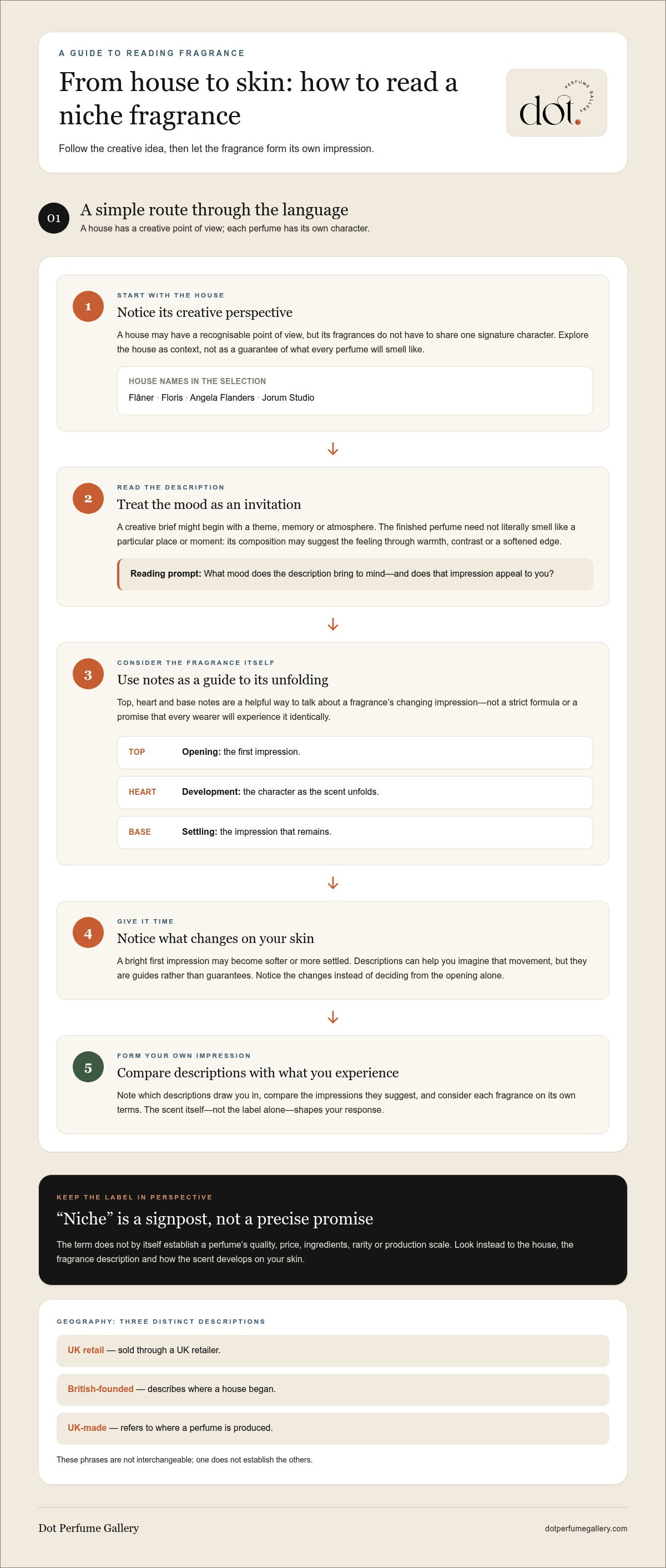
A thoughtful way to explore niche fragrance houses across the UK
It’s easy to begin with a single perfume name, but looking at the house behind it can add another layer to discovery. Try a simple sequence: notice a house, read how it describes its work, then consider one individual fragrance. This gives you context without asking you to memorise terminology or decide too quickly what you like.
How to read a perfume-house profile
Start with the house’s own words. Look for stated inspirations and the language used to describe its fragrances, then distinguish information from the house from a retailer’s interpretation. Evocative phrases can suggest a mood, while specific statements offer details you can separate from the imagery. Avoid assuming notes, origins or methods that aren’t stated.
A retailer’s selection can make it easier to encounter different house names in one place. Dot Perfume Gallery’s range includes Flâner, Floris, Angela Flanders and Jorum Studio. Treat these as starting points for exploration, not shorthand for a particular scent family or approach. A house profile may give you a sense of its language; each fragrance still deserves to be considered on its own terms.
Moving from a house to an individual fragrance
Once a name has caught your attention, compare the descriptions of individual perfumes without turning the exercise into a ranking. Notice words, images or moods that recur, and where the descriptions feel distinct. The aim isn’t to decide which house is best. Instead, form a more considered question to guide your exploration: what am I curious to experience?
Andevalo, Ambre Noir, Carduus and Amber Narcotique are examples of individual fragrances in the gallery’s range. For a closer look at one, the Andevalo fragrance guide explores a single perfume in greater depth. It’s a useful next step when a name or description has already sparked your interest.
If you can’t sample a fragrance first, a separate guide to buying perfume without testing explores that particular situation. More broadly, exploring niche fragrances UK can be as simple as following one thread of curiosity at a time: a house, its language, then a fragrance.
Dot Perfume Gallery brings together fragrances from several houses, with online retail and an in-person shop. To continue discovering at your own pace, explore the fragrance selection and see which descriptions invite a closer look.
Discovering niche fragrances with Dot Perfume Gallery
Exploring niche fragrances UK can be less about finding a single perfect scent and more about discovering which creative perspectives hold your attention. Dot Perfume Gallery is an independent retailer specialising in niche, luxury and British fragrances, with a curated range available online and in person. Its selection brings together different perfume houses, giving you space to follow a name, a description or a passing spark of curiosity.
A curated range for different fragrance interests
One way to begin is by noticing the house behind a fragrance. The gallery’s range includes Flâner, Floris, Angela Flanders and Jorum Studio. Rather than expecting these names to represent one shared style, use them as separate starting points. Read how a house describes its fragrances, then consider individual descriptions and see which words or impressions appeal to you.
You might also begin with a fragrance family or mood that already interests you, then browse descriptions with that curiosity in mind. Treat these as routes through the range, not promises that every perfume within a broad category will smell alike. Names such as Andevalo, Ambre Noir, Carduus and Amber Narcotique offer further points of entry into the gallery’s selection. Each is an individual fragrance to explore, not a shortcut to deciding what will suit you.
Taking a little time with the language can be part of the pleasure. Which descriptions feel inviting? Which make you pause, even if you’re not sure why? You don’t need a polished vocabulary or a settled favourite to begin. A few honest impressions, such as “soft”, “bright” or “comforting”, can help you recognise what draws you in.
When a personal consultation may help
If you’d prefer to talk through your interests, Dot Perfume Gallery offers private perfume consultations by appointment on Tuesday to Thursday evenings. A consultation can help you put your preferences into words, reflect on the descriptions that appeal to you and explore the range with guidance. It’s an optional way to discover fragrance; you can also browse independently and take your time.
Whether you’re following a house you’ve just encountered or returning to a fragrance name that stayed in your thoughts, there’s no need to hurry towards a choice. Let curiosity lead and allow your impressions to become clearer as you explore. Explore Dot Perfume Gallery’s curated fragrance range or arrange a private consultation by appointment.
Let your next fragrance discovery unfold
Your next discovery doesn’t need to begin with a confident choice. It might start with a word that lingers, an image that feels familiar or a fragrance that surprises you once it has settled. Give yourself room to be curious; preferences often become clearer through small moments of noticing, rather than a search for the one perfect answer.
That’s part of the pleasure of exploring niche fragrances UK: each encounter can offer a new mood to consider, without needing to fit a fixed idea of what you should wear. Follow descriptions that speak to you, stay open to unexpected impressions and let your own response guide the pace.
To continue exploring, browse Dot Perfume Gallery’s selection or arrange a private consultation. Explore the fragrance houses and arrange a personal consultation. Your next favourite may be the one you least expected.
Frequently Asked Questions
Does niche perfume always mean a small perfume house?
No. “Niche” isn’t a reliable measure of a perfume house’s size. Its meaning can shift between retailers and fragrance enthusiasts, so don’t infer ownership or production scale from the label. If those details matter to you, look for information the house publishes about its history and operation. Then explore its fragrances on their own merits instead of treating a category word as a complete introduction.
Is niche fragrance always unisex?
No. A niche fragrance may be marketed for women, men or everyone, depending on how its house presents it. These descriptions can help you understand the intended framing, but they aren’t rules about who can wear a perfume. If a gendered label doesn’t reflect how you think about fragrance, set it aside and consider the scent’s own description. Your comfort and enjoyment are more useful guides than a category printed on the packaging.
Are niche fragrances made only from natural ingredients?
No. “Niche” describes positioning in the fragrance world, not an all-natural formula. A perfume may use different kinds of ingredients, and each house’s approach can vary. If you’re looking for particular materials, read the ingredient information for that specific fragrance rather than relying on terms such as “artisanal” or “independent”. Those words don’t by themselves establish that a perfume is natural, organic or entirely plant-derived.
Can you wear niche fragrance every day?
Yes. There’s no rule that reserves niche perfume for evenings or special occasions. The category includes varied moods, so a fragrance that feels comfortable in your everyday routine may suit you better than one chosen for its label. Think about where you’ll wear it and what you enjoy smelling throughout the day. If you’re exploring niche fragrances UK, let your routine and preferences guide you rather than assuming every scent is intended for special occasions.
How should you store perfume to preserve it?
Keep perfume somewhere cool and dry, away from direct sunlight and sudden temperature changes. A bedroom drawer or shelf away from a window is generally a steadier choice than a warm, humid bathroom. Close the bottle after use to limit unnecessary exposure to air, and follow any storage instructions provided by the fragrance house. These habits help reduce avoidable exposure to light, heat and air while keeping the bottle easy to enjoy.
What is the difference between eau de parfum and eau de toilette?
Eau de parfum and eau de toilette are concentration categories, but the label alone can’t tell you exactly how a perfume will smell or perform. Formulas vary between houses, and ingredients, application and individual perception all influence the experience. Treat concentration as one piece of context, not a quality ranking or a promise of lasting power. The individual fragrance description and your own impressions offer a fuller sense of what to expect.