

Woody Niche Perfumes: A Guide to Their Many Moods
What if a woody perfume could feel less like a forest and more like soft suede warmed by the sun? Woody niche perfumes can be dry and crisp, creamy and comforting, or dark with smoky, resinous depth. The wood itself matters, but so do the notes gathered around it.
If the label “woody” has ever felt too broad to guide you, you’re not alone. Ingredient lists can name cedar, sandalwood or vetiver without conveying the impression on skin: pencil-sharp freshness, smooth milky warmth or an earthy, green hush. The most useful question is not simply which wood is listed, but what texture and mood the whole fragrance creates.
This guide explores the character of the main woody materials, then shows how supporting notes can soften, brighten or deepen their effect. You’ll also find a practical way to compare scent directions, take useful notes while sampling and narrow your preferences before choosing a perfume that feels quietly, unmistakably your own.
Key Takeaways
- Woody niche perfumes vary widely in character; surrounding notes help shape whether a composition feels crisp, soft, earthy or deep.
- Cedar, sandalwood, vetiver and patchouli can each lend a fragrance distinct textures and impressions.
- Compare dry, creamy, earthy and resinous directions to identify the woody mood that appeals to you.
- Sample thoughtfully by noting a fragrance’s opening, how it develops and the impression it leaves behind.
- Browse curated fragrances by family or perfume house to explore new scent directions at your own pace.
What Are Woody Niche Perfumes, and What Can They Smell Like?
Woody perfumes centre on wood-like notes or accords, which help define a fragrance’s character. That character might feel dry and airy, creamy and smooth, earthy and green, resinous and deep, or softly warm, like a familiar layer of cloth against the skin. “Woody” describes a broad family of impressions, not one precise smell.
A woody perfume is a fragrance in which wood-like notes or accords shape its character, without needing to feel heavy. Some are quiet and sheer; others are more enveloping. “Niche” describes a category of perfumery, not a particular woody style. It won’t tell you whether a scent suggests pale timber, smooth grain or dark resin. The notes and their balance offer more useful clues.
This distinction makes the family easier to explore. A perfume may place a woody impression at its centre, letting it lead the composition, or use wood as a subtle foundation beneath brighter, softer or more aromatic facets. The shared family resemblance is there, but the balance can feel entirely different. Two woody niche perfumes needn’t create the same atmosphere, any more than two pieces of wood share exactly the same grain or warmth.
Why “woody” describes a family, not one single scent
Family labels group related impressions; they don’t promise identical scent profiles. Think of the contrast between dry timber in a sunlit room, a polished surface with smooth grain and gentle warmth held in fabric. Each comparison suggests a different texture, yet all can help describe a woody direction. The label is a starting point, not a verdict on how a perfume will feel to you.
Notice how prominent the wood seems. In one fragrance, it may be easy to recognise through the heart, the central part of the composition. In another, the woody character may sit quietly in the base, lending depth beneath more noticeable notes. The word “woody” alone won’t reveal that balance. Look for other named notes in the description, then pay attention to which impression stands out when you smell it.
The first impression, the heart and the lingering base
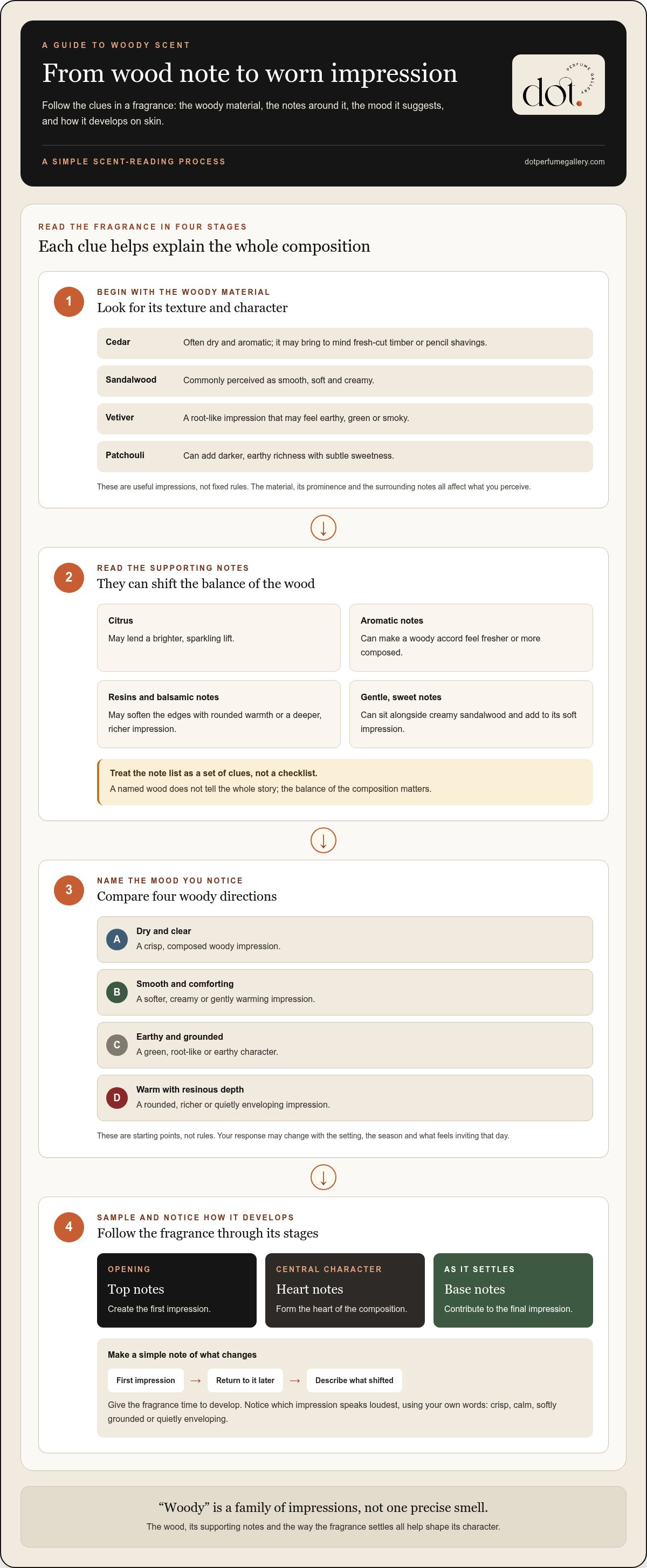
Perfume is often described in three stages: top notes create the opening impression, heart notes form the central character, and base notes contribute to the final impression as the fragrance settles. These are useful ways to talk about a scent’s structure, rather than a guarantee that every perfume will unfold in the same order or with the same emphasis.
A brighter opening may give way to a more noticeable woody heart, or the woodiness may remain gentle beneath other facets. Give a fragrance time to develop before deciding which part speaks loudest. Notice the first impression, then return to it later and describe what has shifted in your own words. The most useful description may be less a technical label than a feeling: crisp, calm, softly grounded or quietly enveloping.
How Cedar, Sandalwood, Vetiver and Patchouli Shape Woody Perfumes
Wood-like notes don’t all create the same atmosphere. Cedar may suggest clean, dry timber; sandalwood often feels smoother and creamier; vetiver can bring an earthy, root-like edge, whilst patchouli tends towards earthy depth with a subtle sweetness. These are helpful scent impressions, not fixed rules. The material, its prominence and the notes around it all affect what you perceive.
One woody material can change a perfume’s mood from crisp and composed to soft, earthy or quietly enveloping. If a note list feels abstract, picture textures instead. Is the fragrance more like dry grain, polished wood or cool, green earth? That shift in attention can help you work out what draws you to a woody composition.
Dry, smooth and earthy woody impressions
Cedar is often described as dry and aromatic, sometimes bringing to mind fresh-cut timber or pencil shavings, though cedar impressions vary between perfumes. Sandalwood, by contrast, is commonly perceived as smooth, soft and creamy. Vetiver comes from a root, and its impression may feel earthy, green or smoky. Patchouli can add darker, earthy richness, but it isn’t present in every woody perfume.
What supporting notes bring to a woody accord
Supporting notes can alter the balance as much as the wood itself. Citrus may lend a brighter, sparkling lift, whilst aromatic notes can make a woody accord feel fresher or more composed. Resins and balsamic notes may soften the edges, adding rounded warmth or a deeper, richer impression. These pairings are possibilities rather than guarantees; each perfume has its own balance and texture.
Read a description as a set of clues, not a checklist. “Cedar” might point towards a drier impression, but citrus could make that wood feel more luminous, while resinous facets might draw it towards warmth. A creamy sandalwood character may seem especially soft beside gentle, sweet notes; vetiver can feel more vivid when its green or smoky side comes forward. Notice which words appeal, then see whether they describe the whole composition or just one part of it.
For a simple comparison, consider the mood you’d like to wear: dry and clear, smooth and comforting, earthy and grounded, or warm with resinous depth. There’s no right answer. Your response may change with the setting, the season and what feels inviting that day.
To explore these scent directions at your own pace, browse curated fragrance collections by family or perfume house. Paying attention to texture can turn a list of notes into a clearer sense of what you might enjoy.
Woody Niche Perfumes Compared: Find the Scent Direction That Appeals
Once you know that woody scents can feel quite different, the next question is personal: which texture would you like to wear? This comparison offers a starting point, not a set of rules. Supporting notes can shift the balance, and your impression depends on how the whole composition comes together. Use the descriptions to name what appeals, rather than to decide which direction is best.
| Direction | Scent impression | Possible supporting notes | Mood it may suggest |
|---|---|---|---|
| Dry | Crisp, aromatic, like dry timber | Citrus, aromatic notes | Clear and composed |
| Creamy | Soft, smooth, rounded | Gentle sweet or floral facets | Comforting and close |
| Earthy | Rooty, green or smoky | Herbal or green notes | Grounded and quietly vivid |
| Resinous | Warm, balsamic, softly rich | Resins, spice | Enveloping and reflective |
These are broad signposts, not boxes. A perfume might open with a bright, dry impression, then settle into a softer, warmer heart; another could pair an earthy character with a smooth, resinous finish. The same fragrance can sit between directions, so look for its overall balance rather than expecting one label to tell its whole story. In woody niche perfumes, that interplay is often what makes a scent distinctive.
Dry and aromatic versus creamy and rounded
Ask yourself which texture you’re drawn to: the crisp impression of dry wood, or the smoother feel of a rounded, creamy accord? Citrus or aromatic facets may lift a dry direction, bringing brightness and definition. Alongside a creamy one, they can offer contrast without removing its softness. Imagine each against your skin, then notice which feels more like your own kind of ease. Neither direction belongs to a particular gender or occasion.
Earthy and resinous versus softly spiced
An earthy direction may bring to mind roots, green ground or a smoky edge. Resinous notes, by comparison, can lend a composition rounded warmth and depth. Spice adds another kind of contrast: it may brighten or enliven the blend, but doesn’t necessarily make the whole fragrance feel overtly warm. Consider whether you prefer a grounded texture, a soft glow or a gentle flicker of contrast.
As you browse, describe the effect in your own terms: crisp, plush, earthy, warm, or a little of several at once. Exploring curated fragrance collections by family or perfume house can help you follow a promising scent direction whilst leaving room for the unexpected.
How to Explore Woody Niche Perfumes Before Choosing
Finding a woody perfume you love is less about recognising every ingredient than noticing what appeals to you on skin. A simple, considered process can help you move from a long list of possibilities to a clearer sense of your preferences. Take your time; you’re looking for a scent that feels right to you, not trying to guess what someone else would choose.
- Identify notes that catch your attention. Look for named woods and supporting notes in a fragrance description. Cedar alongside citrus may suggest a brighter, drier impression; sandalwood with resins might sound smoother and warmer. These are clues, not promises, because the effect depends on the full composition.
- Choose a direction to explore. Begin with a texture or mood you’re drawn to, such as dry and crisp, creamy and soft, earthy and green, or rounded with resin. Compare a few contrasting styles rather than sampling many similar scents at once. The differences are easier to notice when each fragrance has room to make its own impression.
- Sample attentively. When possible, try a fragrance on skin and let it develop before forming a view. Note the opening, what changes later and the overall feeling it leaves with you. A brief first impression can be intriguing, but it doesn’t tell the whole story.
Read fragrance descriptions for clues, not guarantees
A description can help you imagine a perfume’s balance. Dry wood paired with citrus might sound brisk and luminous; an earthy note alongside balsamic facets may suggest something deeper and more rounded. Keep those impressions tentative, then compare them with what you actually smell. If a description names a concentration, treat it as one detail about that particular perfume, not a shortcut to deciding whether its character will suit you.
Sample slowly and record your own impressions
Give each fragrance your attention on its own. If you’re exploring several, space them out so their nuances don’t blur together. A short note on your phone or a page in a notebook is enough to keep track. Record the same details for each fragrance so you can compare them afterwards.
- At first: Write down the opening impression in your own words: bright, dry, green, soft or something else.
- As it develops: Notice whether the wood becomes more apparent, recedes or takes on a different texture.
- Afterwards: Record the feeling the fragrance gives you and whether you’d want to experience it again.
Another person’s favourite may not become yours, and that’s part of the pleasure of exploring. Trust your own response over a single recommendation or fleeting first impression. For a more personal way to discover what suits you, discover private perfume consultations and explore your preferences with a considered guide.
Explore Curated Niche Fragrances with Dot Perfume Gallery
Once you’ve begun to recognise the textures and moods that appeal to you, a considered collection can make discovery feel less like searching through an endless catalogue and more like following a quiet thread. Dot Perfume Gallery is an independent retailer of niche, luxury and British fragrances, with curated collections to explore by fragrance family or perfume house. Start with the direction that caught your attention, then follow your curiosity towards a house whose approach you’d like to discover.
Browsing by family keeps the focus on qualities you’re drawn to, whether that’s a dry, crisp impression, a softer warmth or earthy depth. Exploring by house offers another perspective: it lets you encounter different fragrance-making voices without assuming that one house or collection will have a particular woody style. For anyone exploring woody niche perfumes, these are two useful ways to bring personal preferences into the search whilst staying open to a scent that surprises you.
A considered way to browse niche fragrance houses
Amongst the fragrance houses featured at Dot Perfume Gallery are Flâner, Floris, Angela Flanders and Jorum Studio. Treat those names as invitations to explore, rather than promises of a specific note or scent direction. Browse by family when you already have a texture in mind, or by house when you’re curious about the character of different perfumery voices. Either route can help you narrow your attention without closing the door on discovery.
Keep a few words close as you browse: creamy, dry, green, resinous, soft. They give you a personal reference point, not a rigid filter. If a description catches your eye, pause over the notes and mood it suggests, then compare that impression with what you’ve already enjoyed. A family-led approach can bring related directions into view; browsing by house can reveal how varied those directions may feel.
When personal guidance can make discovery easier
Sometimes it’s easier to describe what you like in conversation than to find precisely the right search term. A private perfume consultation offers a personal setting to share the notes, textures and moods you’re drawn to, along with impressions you’d rather avoid. You might describe the feel of smooth woods, the clarity of a brighter opening or the comfort of a warmer finish. These details can give your exploration a thoughtful starting point, without making a favourite feel like something you have to decide in advance.
Private consultations are available by appointment on Tuesday to Thursday evenings. They offer a personal way to explore fragrance preferences at a measured pace, especially if you’re still discovering which woody direction feels most like you.
Whether you begin with a scent family, a fragrance house or a few words that capture a mood, let your curiosity lead. Explore the curated fragrance collections and continue your discovery with an open mind and room for the unexpected.
Let Your Next Scent Begin with Curiosity
Choosing a fragrance needn’t be a search for a perfect label. Think of it as a small act of noticing: which textures make you pause, which moods feel familiar and which unexpected facets invite you closer? Your preferences can shift with the season or simply with the day, so there’s pleasure in keeping discovery open rather than settling too quickly on a single idea of what suits you.
That’s part of the appeal of woody niche perfumes. They can become a quiet signature, a comforting presence or a fresh departure from what you usually wear. Follow the details that draw you in, and give yourself room to be surprised by what you enjoy on skin.
When you’re ready to continue exploring, browse Dot Perfume Gallery’s curated fragrance collections by family or perfume house. Let your curiosity guide the next step and give yourself time to find the woody scent direction that feels right to you.
Frequently Asked Questions
Are woody perfumes always heavy?
No, a woody perfume can feel light and airy as well as rich and enveloping. The impression depends on the materials, their balance, concentration and the fragrance’s other notes. If you’re concerned about intensity, try a small amount on a test strip first, then on skin if you like the opening. Descriptions mentioning fresh, citrus or aromatic facets can offer useful clues, but your own impression is the best guide.
Are woody niche perfumes unisex?
Woody notes appear in fragrances marketed across different gender categories, and the notes themselves don’t determine who can wear a perfume. If a gendered label doesn’t feel relevant to you, focus on the scent description instead: perhaps you’re drawn to a dry, crisp impression or a soft, rounded one. The same woody direction can feel quite different depending on its accompanying materials, so follow your own preferences.
Can a woody perfume smell fresh?
Yes, woody perfumes can have a fresh character. For example, a composition pairing wood-like notes with citrus or green facets may seem brighter than a description focused on resinous warmth. That’s a possible impression, not a promise: ingredients interact differently in each composition, and a written note list can’t capture every nuance. If freshness matters to you, try the fragrance and notice how it feels after the initial spray.
Can you wear woody perfume in warm weather?
Yes, you can wear a woody perfume whenever you enjoy it. On a warm day, you might prefer a lighter application or a drier, more aromatic character; another person may enjoy a richer scent whatever the season. Rather than following a strict seasonal rule, consider your surroundings and comfort. If you’re unsure, begin with less, then decide whether you’d like a more noticeable presence.
How should you store woody perfume?
Store perfume in a cool, dry place away from direct sunlight and significant temperature changes. A bedroom drawer or cupboard is generally more suitable than a sunny windowsill or a humid bathroom. Keep the bottle securely closed between uses, and avoid leaving it somewhere that warms and cools repeatedly. These habits can limit avoidable exposure, though they can’t guarantee a fragrance will remain unchanged indefinitely.
Can you layer woody perfumes with other fragrance families?
Yes, layering can be an enjoyable way to explore contrast, but the result depends on the particular fragrances and how they interact on your skin. Start with a small amount of each and try one pairing at a time. For instance, test a woody scent alongside a floral one, leaving a little space between applications. Give the combination time to settle, then let your own impression guide you.