

Floral Niche Perfumes: Discover a World of Floral Moods
What if a floral perfume could feel less like a bouquet and more like cool green leaves, soft suede or warm skin? Florals are often imagined as sweet, powdery or unmistakably romantic. Yet floral niche perfumes can explore a far wider landscape of moods and textures, from airy and fresh to velvety, earthy or quietly luminous.
Note descriptions don’t always tell you how a fragrance will feel when you wear it. Rose might suggest petal-soft sweetness, a crisp green edge or something deeper and more intimate. Jasmine can seem radiant, creamy or shaded by woods and spice. This guide explores the different facets of floral perfumery and offers practical ways to work out which ones appeal to you. You don’t need to settle on a favourite at first sniff: start with a mood or texture, then notice how the scent develops.
Key Takeaways
- Floral niche perfumes span many moods and textures. “Niche” describes a perfumery context, not one signature floral style.
- Familiar flowers can suggest different impressions, shaped by the materials and accords around them.
- Floral doesn’t have to mean sweet or delicate. Explore contrasts such as crisp, powdery, shadowed and enveloping.
- Begin with scents you already enjoy, then follow a mood or texture such as green, creamy or woody.
- Explore curated niche, luxury and British fragrances at Dot Perfume Gallery, or discuss your preferences in a private consultation.
What makes floral niche perfumes so varied?
Floral niche perfumes are fragrances in which floral notes or flower-like impressions help shape the scent’s character, interpreted through an individual perfumery style rather than a single shared formula. “Niche” describes a particular creative context; it doesn’t mean a perfume must smell like a soft bouquet or have one recognisable floral mood. A flower might be clear and petal-like, or suggested more abstractly through a green, powdery, woody or richly textured accord.
What does floral mean in perfumery?
In perfumery, “floral” describes a family of impressions, not a promise that a fragrance will smell like a vase of fresh-cut flowers. A floral character might feel dewy and airy, like cool petals in the morning; velvety, like soft fabric; or opulent, with warmth and depth. The word gives you a direction, but not the whole picture.
One flower-like impression may take the lead, making a fragrance feel focused and easy to recognise. In a layered composition, floral nuances sit alongside other facets, so the overall effect may be greener, softer or more abstract than any single blossom. Some perfumes use floral materials; others build a flower-like impression through a blend of notes. For a wider perspective on how flowers produce scent, see Floral scent (flower scent), which explores the volatile compounds behind floral aromas and their biological roles.
Why can two floral perfumes feel completely different?
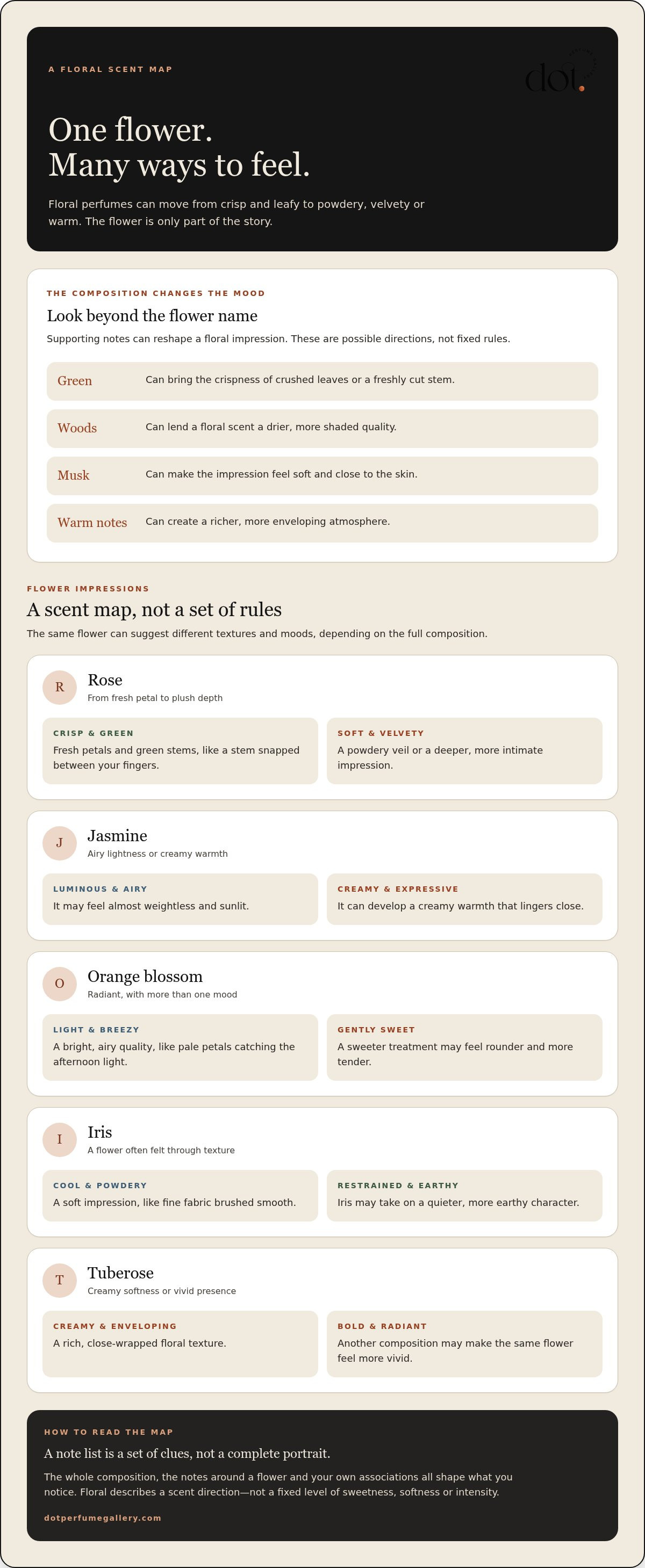
The flower at the centre is only part of the story. Other notes can shift its character, much as a change in light alters the feel of a room. Green facets may give a floral impression the crispness of crushed leaves; woods can lend a dry, shaded quality; musk may make it feel soft and close to the skin. Warm notes can create a more enveloping atmosphere.
Imagine two contrasting interpretations. One feels cool and bright, with a freshly cut stem and a clean, leafy edge. Another is powdery and plush, like petals pressed between the pages of a book. Neither is more “floral” than the other; they simply tell different scent stories. Note lists are useful clues, but not complete portraits. A supporting accord can transform the mood, and the balance between elements matters as much as the flower named.
Some florals don’t immediately announce themselves as a bouquet. A composition may suggest a petal through texture, softness or a fleeting brightness, then move into earthier or woodier territory. That openness is part of the pleasure of floral niche perfumes: the category can hold the familiar and unexpected, the delicate and richly atmospheric, without asking you to choose just one idea of floral.
How do rose, jasmine and other floral facets shape a scent?
Flower names offer a useful starting point, but they aren’t fixed scent instructions. Rose may suggest fresh petals, green stems, soft powder or plush, velvety depth. Jasmine can seem luminous and airy, creamy or richly expressive. Orange blossom often brings a radiant quality, though it may feel light and breezy or gently sweet depending on the notes around it.
Think of these impressions as a scent map rather than a set of rules. A note description points towards an idea; it can’t guarantee that every wearer will experience the fragrance in precisely the same way. The balance of the composition, the materials used and your own associations all contribute to what you notice.
Rose, jasmine and orange blossom: familiar flowers, varied impressions
Imagine rose with a crisp green edge, like a stem snapped between your fingers; then picture it softened into a powdery veil or deepened into something velvety and intimate. Jasmine might feel almost weightless and sunlit, or develop a creamy warmth that lingers close. Orange blossom can bring a bright, airy quality, like pale petals catching the afternoon light. A sweeter treatment may feel rounder and more tender.
These aren’t rigid definitions. Fresh, woody or warm facets can frame the same floral idea, changing its character without erasing its identity. A description such as “rose” or “jasmine” tells you which direction to imagine, not the whole journey the perfume will take.
Iris, tuberose and the more textural side of florals
Some flowers invite you to think less about a recognisable bloom and more about texture. Iris may suggest cool, powdery softness, like fine fabric brushed smooth, or a more restrained, earthy impression. Tuberose can feel creamy and enveloping, yet in another composition it may come across as bold and radiant. Supporting notes can soften, brighten or deepen either effect.
A floral perfume’s character comes from the whole composition, not one flower named on the label. A note list works best as a set of clues. Look at the company each flower keeps: green notes may sharpen its outline, woods may lend a drier finish, and warm accords can create a richer mood. That context helps you imagine more than a single ingredient ever could.
As you explore floral niche perfumes, notice which descriptions draw you in, then stay curious about how the full scent unfolds. Dot Perfume Gallery’s curated collection brings together niche, luxury and British fragrances. Explore niche fragrances and see which floral impressions speak to you.
Are floral niche perfumes always sweet, soft or old-fashioned?
No. A floral character doesn’t automatically mean sugary, delicate or dated. Some florals feel crisp and leafy, like freshly bruised stems; others are cool and powdery, quietly shadowed or richly enveloping. The flower may be only a suggestion, woven into a composition that feels more like texture or atmosphere than a familiar bouquet.
This variety is useful if you’ve previously dismissed florals as too sweet or traditionally feminine. Floral describes a scent direction, not a fixed level of sweetness, softness or intensity. Keeping those qualities separate makes it easier to find floral niche perfumes that suit your tastes, even if your usual favourites are green, woody or dry.
A floral scent need not smell like a bouquet
Some compositions evoke a recognisable petal, whilst others use floral impressions more abstractly. You might sense cool, leafy freshness, then notice a softer floral quality beneath it. Another scent could feel darker and more sensual, with warmth and depth surrounding the bloom. Neither needs to resemble a vase of flowers. The floral aspect can emerge through the overall impression rather than one obvious note.
Use descriptions as invitations to imagine, not promises of a precise smell. “Green” might suggest a crisp edge, whilst “powdery” hints at a soft, dry texture. These words help you picture a direction, but the finished effect depends on how the elements meet.
| Common assumption | A broader interpretation |
|---|---|
| Floral means sweet | A floral can feel green, dry or fresh, with little sugary softness. |
| Floral means delicate | A floral impression can be bold, shadowed or richly enveloping. |
| Floral means old-fashioned | Floral facets can feel crisp, abstract and contemporary in character. |
| Floral means a bouquet | A composition may suggest petals through texture or atmosphere instead. |
Sweetness, softness and intensity are not the same thing
Sweetness describes an impression that may feel sugary, nectar-like or rounded. Softness is more about how a scent seems to sit: perhaps smooth, powdery or close. Intensity describes how vivid or prominent the fragrance feels to you. These qualities can overlap, but one doesn’t automatically cause another. A floral may be restrained yet noticeable, or full and immersive without smelling sugary.
When you read scent descriptions, pause over the specific words. Does “soft” suggest comforting texture to you, or a scent that stays close? Does “rich” sound warm and rounded, or simply more expressive? Your associations matter. Treat each description as a clue, then let the scent itself show you whether its mood feels crisp, powdery, shadowed or cocooning.
How can you find a floral niche perfume that feels right?
Start with what already feels like you. The search for floral niche perfumes needn’t begin with a long list of flower names; it can begin with a mood, a texture or a scent you’ve enjoyed before. Use these clues to narrow the field, not as a test with one correct answer.
Begin with the mood and textures you already enjoy
Think about what you reach for on an ordinary day: something fresh and clear, soft and comforting, warmly enveloping or more dramatic in presence? You might also recall a favourite hand cream, a garden after rain, crisp linen or a familiar woody scent. Those impressions can help point towards floral facets that feel inviting without prescribing a single direction.
- Recall what you like. Name a few scents, places or textures you find pleasing. Perhaps you love leafy freshness, the hush of powder, creamy warmth or the dry comfort of wood.
- Choose a mood. Decide whether you’re hoping for something bright and easy, tender and close, or richer and more expressive. A mood gives your search focus without narrowing it too soon.
- Explore a related floral facet. If you’re drawn to green impressions, look for florals described as fresh or leafy. If you favour softness, powdery or creamy language may catch your attention; a preference for wood can lead towards floral compositions with a drier, grounded feel.
Keep your preferences flexible. A fabric you love might suggest a texture rather than a note: smooth silk could bring to mind luminous softness, whilst wool might feel warm and cocooning. These associations aren’t rules. They’re personal starting points that can help you notice what draws you in.
Read descriptions as invitations, then experience the scent
Note lists and scent descriptions can help you form an expectation, but they can’t fully reproduce a perfume’s character. Words such as “green”, “powdery” or “woody” offer clues, while the way those facets come together creates the larger impression. If woody contrasts interest you, explore this guide to woody niche perfumes for another way to think about scent moods.
Keep your first exploration simple. Compare a small number of contrasting profiles rather than trying to assess everything at once: perhaps one that sounds fresh, one that seems soft, and one with a warmer or woodier character. Give each your attention. Notice which description made you curious, what stands out as you experience the fragrance, and whether the overall mood feels comfortable or surprising.
There’s no need to decide immediately. A private perfume consultation can provide a thoughtful setting to explore your preferences. Dot Perfume Gallery offers private consultations by appointment on Tuesday to Thursday evenings. Explore a private perfume consultation as a considered way to find a scent direction that feels personal.
Where can floral niche perfume discovery lead next?
Finding a floral direction isn’t a decision you need to make in a single sitting. Let curiosity guide you: one fragrance may clarify that you prefer a crisp, leafy impression, whilst another reveals a fondness for powdery softness or deeper warmth. Even a scent you don’t love can be useful. It may help you name what feels too sweet, too airy or simply unlike you. Your preferences can shift with season, setting and mood, so discovery can stay open.
A useful next step is to explore beyond one note or one style. A curated selection can introduce different creative perspectives and help you notice how fragrance houses interpret character and atmosphere. Dot Perfume Gallery brings together niche, luxury and British fragrances, including work from Floris, Angela Flanders, Flâner and Jorum Studio. These offer wider avenues for fragrance discovery, rather than implying that every house or fragrance follows a floral direction.
A considered way to continue exploring fragrance
As you browse, hold on to the words that felt most useful: green, creamy, powdery, woody, luminous. They can help you describe what you’re drawn to, while a range of fragrance houses offers fresh ways to think about style and expression. There’s no need to follow a strict path. Let a new impression surprise you and allow your preferences to become clearer with each discovery.
When a personal consultation can help
Sometimes it’s easier to articulate a preference in conversation. A private perfume consultation can help you put words to the scents, textures and moods you enjoy, then explore fragrance directions with those preferences in mind. It’s a personal way to approach discovery if you’d value guidance rather than browsing alone.
At Dot Perfume Gallery, private perfume consultations are by appointment on Tuesday to Thursday evenings. You might arrive with a clear favourite, a note you’re curious about, or only a sense of how you want a fragrance to feel. Each is a useful place to begin; the aim is to explore thoughtfully, not to force an instant answer.
Keep a few simple observations as you go: which impressions draw you closer, which feel less like you, and what you’d like to experience next. Over time, those clues can form a more personal scent vocabulary, making future discoveries feel less like guesswork and more like recognition.
Explore Dot Perfume Gallery and continue your fragrance discovery at your own pace.
Let your next scent discovery unfold
Let curiosity take the lead. The floral niche perfumes that stay with you may not be the ones you expected; a passing impression, a changing season or a new mood can reveal a different side of your taste. Keep a short note of what draws you in and let those observations shape your next exploration. There’s no need to find one perfect answer. Your fragrance preferences can evolve, just as the stories you want a scent to tell can change.
Dot Perfume Gallery brings together curated niche, luxury and British fragrances, offering a thoughtful starting point for further discovery. If conversation would help you put your preferences into words, private perfume consultations are available by appointment on Tuesday to Thursday evenings.
Explore Dot Perfume Gallery and follow the scent that feels most like you. A little curiosity is all you need to begin.
Frequently Asked Questions
Are floral niche perfumes only for women?
No. “Floral” describes a fragrance family, not a gender or a rule about who can wear it. Anyone drawn to rose, jasmine, iris or other flower-like impressions can enjoy exploring them. Ask whether the fragrance feels at ease with your style and the way you like to present yourself. Labels may offer a starting point, but personal comfort is a better guide.
Can floral niche perfumes work as an everyday signature scent?
Yes, if the fragrance feels natural across the different settings in your life. You might prefer a light, green impression for a relaxed daytime routine, or something more enveloping for evenings and special occasions. Consider how its mood and presence suit your usual pace, rather than deciding from its floral label alone. Give yourself time to experience the scent before making it part of an everyday ritual.
How long do floral niche perfumes last on the skin?
There’s no single duration that applies to every floral perfume. Longevity can vary with the individual composition and concentration, how much you apply, your skin and the conditions around you. A fragrance may also change in character as its opening gives way to later impressions. Notice how it wears through your own day; a family name or list of notes can’t reliably predict how long you’ll perceive it.
What happens if a floral perfume smells different on my skin?
That’s a normal part of experiencing fragrance, not necessarily a sign that anything is wrong. As a perfume unfolds, some facets may become more noticeable than they were at first, and skin, temperature and surroundings can influence what you perceive. Try not to judge it from the first moments alone. If its overall character still feels unlike you after some time, that’s useful information to carry into your next discovery.
Are floral niche perfumes made with real flower extracts?
Not necessarily. A floral impression might come from natural materials, aroma molecules or a blend of different ingredients; the flower named in a description doesn’t guarantee an extract from that bloom is present. Perfumers can also build a flower-like effect through several materials working together. If you’re interested in a particular ingredient, look for product information that identifies it, rather than assuming the scent description is a full ingredient list.
Is a niche floral perfume the same as a designer floral perfume?
No. “Floral” describes a scent family, whilst “niche” and “designer” refer to different perfumery and brand contexts. Either can include floral fragrances, and neither label alone tells you how a particular perfume will smell. “Designer” doesn’t automatically mean sweet, just as “niche” doesn’t guarantee an unusual or intense floral. Read descriptions for clues about the individual composition, not as a substitute for experiencing it.