

How to Choose a Niche Perfume: A Thoughtful Guide
What if the right niche perfume isn’t the one with the most beautiful description, but the one that feels quietly familiar once it’s on your skin? It’s easy to be drawn to a list of notes or an evocative story, then find the fragrance unfolding quite differently when you wear it. If you’re wondering how to choose a niche perfume, begin with what you want to feel, not just what you want to smell.
The choice can seem overwhelming when every house has its own language and every bottle suggests a different mood. Perfume descriptions can be hard to translate into a wearing experience. This guide will help you identify the settings, memories and sensations that draw you in, then compare fragrances using a simple set of questions. You’ll look at how a scent develops on your skin, how to assess it beyond the first impression, and how season and occasion can shape your response. Take the process gently: the right fragrance should feel less like a decision made in haste and more like a discovery you’re glad to return to.
Key Takeaways
- Start with the mood, familiar comforts and occasions you want a fragrance to accompany, rather than trying to master perfume terminology.
- Read notes as clues to a scent’s character, not a literal recipe or a guarantee of how it will smell on your skin.
- Compare a short list of candidates by comfort, character, setting and how they feel over time, using words that make sense to you.
- Learn how to choose a niche perfume by noticing your response, revisiting your preferences and allowing yourself time to decide.
- Explore fragrances by perfume house or family, or consider a private consultation for individual guidance.
Choosing niche perfume: start with the feeling you want
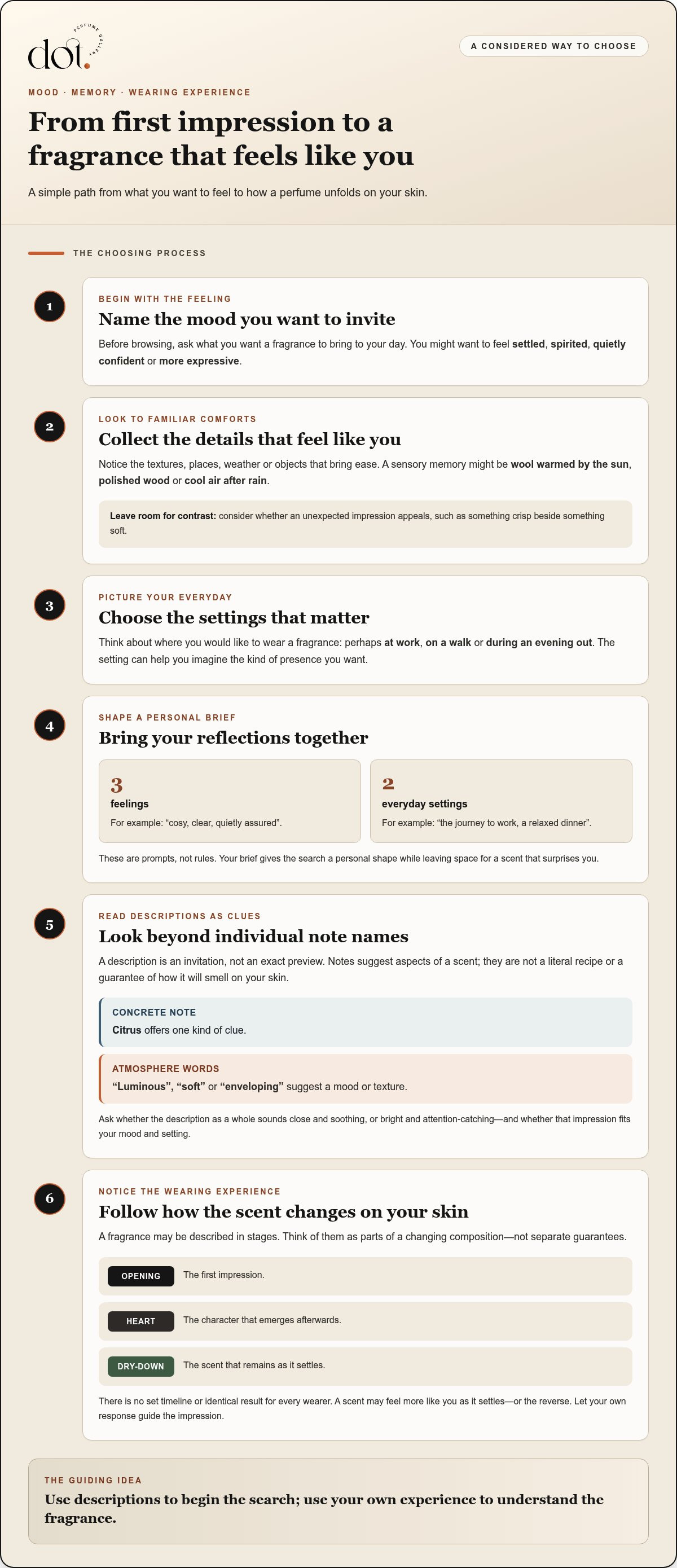
You don’t need a trained nose or a fluent command of perfume vocabulary to choose well. Start by noticing what you’re drawn to: the warmth of a familiar jumper, the hush of a rainy afternoon, the brightness of an open window. Before browsing, ask what you want a fragrance to bring to your day. A little self-knowledge can make a wide field of possibilities feel more personal and manageable.
Try this short reflection. Jot down a few words in response to each prompt:
- Desired mood: Do you want to feel settled, spirited, quietly confident or more expressive?
- Familiar comforts: Which textures, places, weather or objects bring you a sense of ease?
- Curious contrasts: Are you drawn to something unexpected beside those comforts, such as a crisp impression against a soft one?
- Everyday occasions: Where would you like to wear a fragrance, perhaps at work, on a walk or during an evening out?
These aren’t rules or labels. They’re a starting point for how to choose a niche perfume with your own life in mind, rather than being led by a striking name or a description that sounds beautiful but is hard to picture. For a broader introduction to independent perfumery, explore this guide to niche fragrances in the UK.
What does niche perfume mean for a first-time explorer?
Think of niche perfumery as a broad part of fragrance culture, not a promise of one particular style. It doesn’t automatically mean a scent will be natural, rare, superior or challenging. Different houses have distinct creative directions, approaches to composition and stories to tell through fragrance. A little background on perfume’s history, composition and classifications appears in the Wikipedia article on Perfume, though your own response remains the most personal guide.
A fragrance family can help you sort impressions, but it isn’t a personality test. You might enjoy a familiar family in one setting and feel curious about another in a different one. Preferences can shift with the weather, the occasion or simply your mood. Treat categories as signposts, not boundaries.
Build a personal fragrance brief from mood and memory
Gather your reflections into a small brief: three feelings and two everyday settings. For instance, you might write “cosy, clear, quietly assured” and “the journey to work, a relaxed dinner”. Add a sensory memory if one comes to mind: wool warmed by the sun, polished wood or cool air after rain. These details give your search a human shape without requiring you to translate every association into a note.
Then consider the kind of presence you want. Should the fragrance feel familiar, offer a gentle contrast, sit close and quietly accompany you, or leave a more expressive impression? You don’t need one answer for every moment. The purpose of your brief is to help you recognise what feels promising while leaving room for a scent that surprises you.
How to read a niche perfume description without getting lost in notes
A perfume description is an invitation, not an exact preview of what you’ll experience. Fragrance notes are descriptive elements that communicate aspects of a scent, from brighter accents to deeper, softer impressions. They can give you a helpful first picture, but they aren’t a literal recipe or a promise that every wearer will perceive the fragrance in the same way.
As you consider how to choose a niche perfume, read the description alongside your personal brief. If you’re hoping for a quiet, comforting presence, ask whether the overall language fits that mood, rather than focusing only on whether a listed note sounds appealing. A familiar note can feel surprising in a different composition, while an unfamiliar one may be softened by the fragrance around it.
Read scent descriptions as impressions, not guarantees
Separate concrete note names from words that describe atmosphere. A note such as citrus gives you one kind of clue; words such as “luminous”, “soft” or “enveloping” suggest a mood or texture. Neither tells the whole story. Ask what each word brings to mind for you: “soft” might suggest a cashmere scarf, a powdery finish or something barely perceptible. Your association is useful, even if someone else imagines something quite different.
Then look for the broad impression created by the description as a whole. Does it sound close and soothing, or bright and attention-catching? Does its emotional language fit the mood and setting you have in mind? You don’t have to understand every term. Notice what draws you in, what gives you pause and which phrases connect with the experience you’re seeking.
Notice how a fragrance unfolds over time
Descriptions may divide a fragrance into an opening, a heart and a dry-down. These terms refer to stages in its development: the first impression, the character that emerges afterwards and the scent that remains as it settles. Think of them as parts of a changing composition, not three separate guarantees. The opening alone may not represent the full wearing experience.
A fragrance can develop differently on different wearers, so don’t expect a set timeline or identical results on every skin. If a description mentions a lively opening and a warmer, softer dry-down, consider whether that change sounds appealing for the occasions you have in mind. A fragrance may catch your attention at first, then feel more like you as it settles, or the reverse.
For a specific example of reading a scent in context, the Andevalo perfume guide explores one fragrance through its scent and character. To continue exploring descriptions across different houses and families, browse fragrances by house or family, letting the language guide your curiosity without deciding for you.
How to compare niche perfumes by comfort, character and context
Once you have a few possibilities in mind, resist the temptation to consider everything at once. Choose two or three candidates and compare them against the same personal brief. A short list makes the differences easier to notice: one may feel comforting, another more vivid, while a third may seem better suited to a particular setting.
Use a simple record in your own words. There’s no need to rate a fragrance as objectively “good” or “bad”. The useful question is whether its character and presence suit you.
What to compare
Your notes
Personal brief
Which of your hoped-for feelings does it bring to mind?
Comfort
Does it feel easy to wear, distracting, reassuring or unexpectedly expressive?
Setting
Can you picture it in an everyday routine, a quiet moment or a special occasion?
After time
How does your impression change as the fragrance settles?
Compare what each fragrance feels like to wear
Notice the difference between the opening impression and the feeling that remains later. A fragrance that first seems bright and noticeable might settle into something softer; another may hold a more vivid character than you expected. Write down your response, not just the notes: “calming at first, then too present” tells you more about your comfort than a list of ingredients.
Projection and longevity may matter to you, but they aren’t measures of quality, and no single expectation applies to every wearer. Consider whether you’d like a scent to stay close or be more perceptible, and whether you enjoy noticing it throughout your day. Your preference is the point, not a contest between styles.
Match a candidate to the setting you have in mind
Picture the fragrance in an ordinary setting, perhaps during your commute or while reading at home, then in a moment that feels more special. Does it seem like an easy companion or a deliberate statement? Either can be right. Setting is a way to understand your own preference, not a rule about who may wear a particular scent or when.
The best comparison depends on the wearer’s preferences and intended use, not on a universal ranking of fragrances. If one candidate feels comfortable across the settings you care about, while another suits a mood you’d like to inhabit occasionally, both observations are valuable. Keep your notes personal and specific; they’ll help you see which fragrance feels most at home in your life.
How to make a considered choice after experiencing a niche perfume
A first impression can be compelling, but it doesn’t have to make the decision for you. Pause to separate the pleasure of discovering something unusual from the quieter question of whether you’d enjoy wearing it. A fragrance can be fascinating without becoming a favourite, and a subtle scent may grow more appealing as you imagine it alongside the rhythms of your life.
Use this short sequence to bring your impressions together:
- Revisit your brief. Read the feelings and settings you noted earlier. Which qualities were you hoping to find?
- Experience one candidate. If you can, notice your initial response, then let the fragrance develop as you go about an ordinary part of your day.
- Record what you actually enjoyed. Note what drew you in, how comfortable it felt and whether your response changed over time.
- Decide without rushing. Ask whether you can picture choosing to wear it again, or whether your interest rests mainly on its novelty.
Use a simple reflection to separate curiosity from comfort
Try writing two short phrases: “I was curious because…” and “I enjoyed wearing it when…”. The first might capture a striking description or an unexpected character; the second helps reveal whether the scent felt pleasing in practice. Then return to your original brief. If the fragrance fits the mood or setting you had in mind, curiosity and comfort may be meeting. If it doesn’t, that’s useful information, not a failed choice.
There’s a difference between admiring a fragrance and wanting it close to you again. Neither response is more sophisticated. The question is whether its character feels right for the way you’d like to wear it, rather than whether it seems unusual enough to impress.
Know when a fragrance deserves more consideration
Notice whether the scent remains appealing beyond its opening impression. Perhaps a bright start settles into something reassuring; perhaps an intriguing first moment becomes too present for your taste. If your feelings are mixed, give them room. Uncertainty can be a reason to pause and reflect, not proof that the fragrance is wrong. There’s no universal number of wears or days that should determine your answer.
If you’re considering a fragrance without experiencing it first, your decision naturally carries more uncertainty. Descriptions, notes and other people’s impressions can offer clues, but they can’t fully capture your own response. That doesn’t make choosing impossible; it simply means weighing what you know against what you’re willing to discover. For that situation, the guide to buying perfume without testing offers further perspective.
When you feel ready to explore your shortlist with individual guidance, discover the fragrance collections and private consultations at Dot Perfume Gallery.
Where to continue your niche perfume search with thoughtful guidance
You’ve gathered clues about what draws you in, what feels comfortable and where you might wear a fragrance. Now choose a next step that suits your confidence. If you’re happy to browse independently, a curated selection organised by house or fragrance family can give your search a helpful shape. If you’d value a conversation, individual guidance can help you articulate what you’re looking for and consider possibilities you might not have found alone.
There’s no need to arrive with a perfect brief or a glossary of perfume terms. A few words about the moods, settings or impressions you enjoy are enough to begin. Keep your notes nearby, but let them guide your curiosity rather than narrow it too soon.
Explore a curated range without needing to know every note
Browsing by fragrance family offers one way into a broad selection; exploring by perfume house offers another. Each route gives you a different starting point, whether you have a general sense of the styles you’re curious about or would rather follow a house’s creative identity. At Dot Perfume Gallery, the range includes houses such as Flâner, Floris, Angela Flanders and Jorum Studio. Explore their fragrances without deciding in advance what each one should smell like.
As you browse, return to the language that feels meaningful to you. Notice which descriptions spark a memory, suggest a setting or simply make you want to learn more. If you’ve already compared a few candidates, your personal notes can help you keep exploring with focus. If you’re just beginning, following a family or house that catches your attention can be a relaxed way to discover what resonates.
When a private perfume consultation may be helpful
A private perfume consultation may suit you if you’d appreciate an individual conversation as you refine your preferences. Bring a few words from your fragrance brief, impressions from scents you’ve experienced, or questions about the descriptions you’ve been reading. The discussion gives you space to explore those thoughts with guidance, without needing to arrive as an expert or having made a decision already. Private consultations are available by appointment on Tuesday to Thursday evenings.
Choosing how to choose a niche perfume is ultimately a personal process: a way of noticing what feels right on your skin and in the moments you want to inhabit. Whether you’re ready to browse on your own or would prefer a conversation, let your next step reflect your curiosity, not pressure to settle on a fragrance immediately. You’re warmly invited to explore Dot Perfume Gallery’s fragrance collections at your own pace.
Let your next fragrance discovery unfold
Your relationship with fragrance can change with the seasons, the places you spend time and the memories you gather. A scent that feels intriguing today might become a treasured companion, or simply open the door to a new direction. There’s no need to find one perfect answer straight away. Let curiosity lead and allow your preferences to become clearer through experience.
If you’re still considering how to choose a niche perfume, take one small next step: explore a house or fragrance family that speaks to your imagination. Follow what draws you in, while giving yourself permission to change course. The right choice needn’t be the boldest or most unexpected; it’s the one you’ll be glad to return to.
Explore Dot Perfume Gallery’s curated fragrance collections and see where your curiosity takes you. Browse by perfume house or fragrance family, or book a private consultation for individual guidance.
Frequently Asked Questions
Does niche perfume always contain natural ingredients?
No. “Niche” describes a part of the fragrance market, not a guarantee that a perfume is made entirely from natural ingredients. Fragrances can use different materials and approaches, and note lists don’t establish where those materials come from. If ingredient origin matters to you, look at the specific product information and rely on details it states, rather than inferring a formula from evocative descriptions or a house’s positioning.
Is niche perfume always more expensive than designer perfume?
Not necessarily. “Niche” doesn’t set a single price or reliably tell you how a particular fragrance is positioned. Prices vary between houses and products, so compare the options you’re considering rather than assuming the category gives you the full picture. Consider whether the scent’s character and wearing experience feel worthwhile to you, alongside the amount you’re comfortable spending.
Can one niche perfume work for every season?
Yes, if you enjoy wearing it in different conditions and settings; there’s no universal rule that a fragrance belongs to one season. A scent might feel cosier with a scarf and coat, or more noticeable in warmer weather, but those impressions are personal. Notice when you naturally reach for it and whether you still enjoy it across your routine. Your experience matters more than a seasonal label.
How do I know whether a niche perfume is right for me?
Look beyond whether you admire the description or enjoy the opening. Ask whether you feel at ease wearing it, whether its changing character continues to appeal, and whether you’d choose it for a setting you care about. As you consider how to choose a niche perfume, remember that your preference needn’t impress anyone else or fit the idea of a signature scent. Your own pleasure is a sound reason to choose.
Is niche perfume only for women or men?
No. A fragrance’s marketing or category labels don’t decide who can enjoy wearing it. If a scent appeals to you, consider its mood, materials and overall character, then imagine how it might fit into your everyday routine. You might be drawn to a fragrance marketed towards a different gender, or find that label irrelevant altogether. Let your own response lead rather than narrowing your search by assumption.
How should I store perfume to preserve it?
Keep perfume in a stable place away from direct sunlight, excessive heat and frequent temperature changes. A cupboard or drawer can protect the bottle from light; replace the cap after use, and avoid leaving it somewhere warm or humid, such as beside a radiator. Check the storage guidance supplied with the specific fragrance, as its packaging may include instructions relevant to that product.