

Niche Perfume Versus Designer Perfume: What Really Differs?
The less familiar label isn’t automatically the more beautiful scent, and a celebrated designer name doesn’t guarantee a fragrance will suit you. The question of niche perfume versus designer perfume can feel clouded by confident claims about ingredients, quality and staying power, but the labels don’t tell the whole story. If you’re wondering whether a different category could lead you to a fragrance that feels more like you, start by separating the house’s identity from the scent itself.
The useful distinction is usually a house’s focus and how it presents its fragrances, not a simple ranking of better and worse. This guide explains what the labels can suggest, which differences may matter to your choice, and which assumptions to set aside. As you compare brand identity, distribution and scent character, keep your own preferences at the centre. Houses such as Floris, Angela Flanders and Jorum Studio offer different perspectives on fragrance, but the best way to find a scent that feels like a soft second skin is to notice how it smells to you, whatever its label.
Key Takeaways
- Learn what niche and designer labels can suggest, and why neither has one universal definition.
- Compare brand focus, creative positioning and distribution without assuming either category guarantees better quality.
- Use the niche perfume versus designer perfume comparison to focus on the scent and details that matter most to you.
- Explore fragrances by starting with what you enjoy, noticing each scent’s character, then experiencing it on your skin.
- A private perfume consultation can help you put your preferences into words and explore different fragrance-house perspectives.
Niche Perfume Versus Designer Perfume: What Do the Labels Mean?
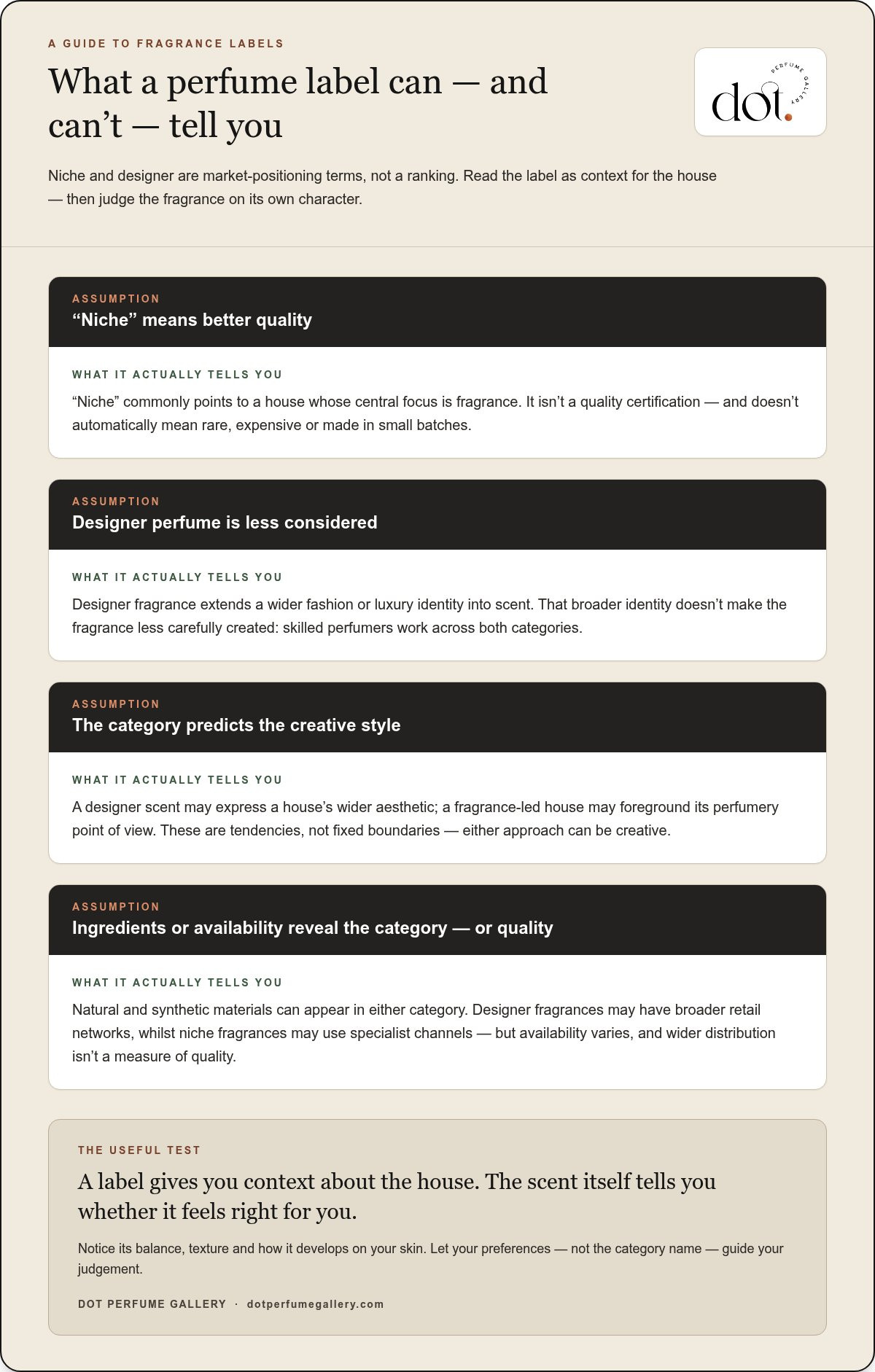
In broad terms, designer perfume is fragrance created under a fashion or luxury house’s wider identity, whilst niche perfume is commonly associated with houses whose central focus is fragrance. These are market-positioning terms, not categories with one universal legal meaning. Their boundaries can overlap, so the label gives you context about a house, not a verdict on the scent.
A designer fragrance may reflect a house’s visual style, materials, mood or wider creative story. A fragrance-focused house, by contrast, may put scent-making at the heart of its identity. Either way, the perfume is a composition of materials and impressions. The history and composition of perfume offer useful context for understanding how varied this art can be.
What does niche perfume mean?
“Niche” generally describes how a fragrance house is positioned and what it chooses to specialise in. Scent may be its principal creative concern, giving the house room to develop a recognisable point of view. Specialisation is a common characteristic, not a rule that neatly applies to every brand. The term isn’t a quality certification, and it doesn’t automatically mean a perfume is rare, expensive or made in small batches.
Think of “niche” as a clue to the conversation a house wants to have with you, rather than a promise about what you’ll smell. Some niche houses explore unusual contrasts; others make familiar, comforting compositions with a distinctive touch. The word alone can’t tell you whether a fragrance will feel original to your nose or whether you’ll want to wear it.
What does designer perfume mean?
Designer perfume extends a broader fashion or luxury identity into fragrance. The house’s established aesthetic may shape the bottle, campaign and story around the scent, placing the perfume within a larger creative world. That wider identity doesn’t make the fragrance less considered. Skilled perfumers can work across both designer and niche categories, bringing technical knowledge and artistic judgement to either.
Brand focus tells you where a house places its identity; the scent itself tells you whether the perfume is well made and right for you. A label can influence expectations, but it can’t settle questions of balance, texture or personal enjoyment. “Niche” isn’t shorthand for more creativity, just as “designer” doesn’t automatically mean a familiar or less adventurous style.
Exploring houses such as Floris, Angela Flanders and Jorum Studio can show how varied a fragrance house’s perspective may be. Their names are a starting point for discovery, not a substitute for smelling a perfume and noticing how it develops for you. In the niche perfume versus designer perfume discussion, the useful question isn’t which label wins. Ask what the label helps you understand, then let your own senses decide whether the fragrance suits you.
How Niche and Designer Fragrances Differ in Creation and Distribution
The distinction is best understood as a difference in emphasis, not a fixed production recipe. A fashion house may carry its wider visual identity into fragrance, whilst a fragrance-led house may build its identity around scent. Both approaches can involve careful creative direction, professional perfumers and rounds of development. The finished perfume is more than a simple reflection of its label.
Brand focus, creative direction and perfumers
A designer brief might draw on a house’s clothes, heritage or imagined world to shape a fragrance’s mood and presentation. A fragrance-focused brand may begin with a scent idea or a particular perfumery perspective instead. Neither approach rules out creativity. Perfumers and fragrance companies, including Givaudan, Firmenich and IFF, can contribute to fragrance development across the market, with the creative brief guiding the work.
Creating a perfume involves choices about how materials interact, how a scent unfolds and the impression it leaves. For an introduction to the chemistry behind perfume creation, the American Chemical Society explores the relationship between scent and chemical composition. The process can be intricate in either category. A wider fashion identity doesn’t mean a fragrance is mechanically or creatively simple.
Brand focus: Designer houses often connect fragrance to a broader fashion or luxury identity; niche houses are commonly more fragrance-led.
Creative positioning: A designer scent may express a house’s wider aesthetic; a niche scent may foreground its perfumery point of view. These are tendencies, not boundaries.
Distribution: Designer fragrances may be available through broader retail networks, whilst niche fragrances may be found through more specialist channels. Availability varies by house and fragrance.
Ingredients, production and where fragrances are sold
Natural and synthetic materials can be used in fragrances across both categories. Neither is a dependable sign of a niche or designer label, and neither tells you by itself whether a scent will feel luminous, soft, green or resinous on your skin. Houses can also differ in how they make and distribute their fragrances, so production scale and availability aren’t reliable ways to classify a perfume.
A perfume’s label can suggest its brand context, but it can’t reveal its complete formula. Wider availability doesn’t mean lesser quality: it describes where a fragrance can be found, not how carefully it was composed or how it will wear. When comparing niche perfume versus designer perfume, treat claims about ingredients, scale and distribution as details to consider, not rules that settle the choice.
Dot Perfume Gallery brings together fragrances from houses such as Floris, Angela Flanders and Jorum Studio, offering different creative perspectives to explore. For a focused conversation about what you enjoy, you can arrange a private perfume consultation by appointment on Tuesday to Thursday evenings.
Niche Perfume Versus Designer Perfume: Which Differences Matter Most?
A useful comparison begins with your experience, not a league table of labels. One fragrance might feel familiar and quietly reassuring; another might seem unusual, expressive or difficult to place. Those qualities come from the individual composition, not reliably from whether a house is described as niche or designer. Ask whether the scent’s character feels right for you and the moments or settings you have in mind.
Scent character, familiarity and personal taste
Notice what you’re drawn to: soft or vivid, airy or enveloping, recognisable or unexpected. A polished floral or warm woody scent could come from either category, and an adventurous composition isn’t exclusive to niche houses. Your response matters more than assumptions about what other people find popular. The historical evolution of perfumery is another reminder that fragrance styles change over time, so today’s categories don’t neatly predict a scent’s character.
| What to compare | Useful question | What the label can tell you |
|---|---|---|
| Scent character | Do I enjoy its notes and overall mood? | Little about the specific way it smells. |
| Brand story | Does the house’s point of view interest me? | Some context for its wider identity. |
| Presentation | Do the bottle and setting appeal to me? | How the fragrance is presented. |
| Availability | Where can I encounter this fragrance? | Possibly a clue to distribution, not quality. |
Quality, longevity and the myths behind the labels
Niche doesn’t automatically mean superior. The category alone can’t establish the quality of a fragrance’s materials, its balance or how long it will last on your skin. These qualities vary from scent to scent, and a perfume may develop differently on different wearers. You might enjoy a rich, lingering impression, whilst someone else prefers a softer presence that stays close.
Instead of judging from the name on the bottle, give the fragrance time to unfold. Notice the first impression, then how it changes as it settles. Ask yourself whether you still enjoy it after the opening has softened. When weighing niche perfume versus designer perfume, compare the scents and consider the house’s story, distribution and presentation separately. A compelling brand narrative can add to the pleasure of a fragrance, but it doesn’t prove the perfume is right for you.
There’s no need to favour novelty over familiarity, either. A recognisable scent may suit your everyday rituals beautifully, whilst a more unusual one may offer a welcome change of mood. Let curiosity guide you, but give your own enjoyment the final word.
How to Compare Niche and Designer Perfume with Your Own Preferences
A good comparison starts with your habits, not a category checklist. Think of the fragrances you reach for when you want to feel composed, comforted or quietly noticed. Then explore beyond those familiar choices without expecting a new house or a more unusual scent to be automatically better suited to you. Niche perfume versus designer perfume is a simpler question to answer once you know how you want a fragrance to feel.
Start with the fragrances and notes you already enjoy
Make a note of the scents you love wearing and what draws you to them: perhaps a fresh, airy quality, a floral softness or a warm, deep finish. Mood matters too. Do you prefer something close and calming, or more expressive? These impressions give you a personal starting point and leave room to discover unfamiliar fragrance houses without making novelty the goal.
Compare the experience, not only the label
Try one fragrance at a time. Notice its opening, then return to it as it develops on your skin. This gives each scent room to unfold and helps you separate genuine enjoyment from the first impression of a beautiful bottle or compelling brand story. For background, explore niche fragrances in the UK and the perspectives of independent perfumery.
- Name what you enjoy. Describe the mood, texture or broad fragrance family you tend to seek out. You don’t need technical vocabulary; “soft and comforting” or “bright and lively” is a useful beginning.
- Notice the scent itself. Ask whether the fragrance feels familiar, distinctive, gentle or expressive to your senses. Keep that response separate from what you think the label is supposed to mean.
- Experience it on skin. Pay attention at first application, then again later as the scent settles. Consider whether you enjoy the change, not just whether the opening caught your attention.
Give the brand story its own place in your decision. You might admire a house’s history or creative world yet feel less drawn to its perfume; another scent may delight you before you know much about its maker. Both responses are useful. This guide to choosing a niche perfume offers further prompts for exploring your preferences.
Your eventual favourite might be niche, designer or a mix of both, chosen for different days and moods. To put your preferences into words and explore different fragrance-house perspectives, you can arrange a private perfume consultation by appointment on Tuesday to Thursday evenings.
Explore Niche and Designer Perfume Through a Thoughtful Fragrance Experience
After comparing the labels, the most satisfying next step is to let your own senses lead rather than declare a winner. A fragrance description can suggest its mood, and a house’s identity can spark curiosity, but neither can fully convey how a scent will feel to you. Whether you’re exploring niche perfume versus designer perfume, give yourself room to discover without choosing a category first.
Why sampling can make the comparison more personal
Experiencing a fragrance on skin gives you a more personal impression than reading a label or description alone. Notice the first impression, then return to the scent as it develops; an opening that feels bright may soften, deepen or change direction. There’s no need to rush to a verdict. Taking time helps you recognise what you genuinely enjoy, rather than choosing solely because a name or story sounds appealing.
If you can’t try a fragrance before buying, reflection can still help. Think about the scents you already enjoy, the moods you want to evoke and the descriptions that appeal to you, whilst remembering that your experience may differ from someone else’s. This guide to buying perfume without testing offers further considerations for making a choice from a distance.
Keep your impressions simple. You might note whether a scent feels comforting or lively, soft or pronounced, familiar or surprising. These words aren’t a scorecard; they help you pay attention to your own response. If one fragrance doesn’t suit you, that doesn’t determine how you’ll feel about the wider category or another scent from the same house.
A consultation shaped around your scent preferences
You don’t need expert vocabulary to talk about perfume. A private consultation can begin with the fragrances you already love, the notes or moods that draw you in, and what you’re curious to explore. It’s a focused conversation to help you articulate your preferences and discover different fragrance-house perspectives, not a test with a right answer.
At Dot Perfume Gallery, private perfume consultations are available by appointment on Tuesday to Thursday evenings. The collection includes niche, luxury and British fragrances from houses such as Floris, Angela Flanders and Jorum Studio, offering different points of view to explore. You might find a new favourite in one category, the other or across both. Let your response, not the label, shape the discovery.
For further context on independent perfumery, explore niche fragrances in the UK. When you’re ready to continue, take a look through the fragrance collection and follow whichever scents invite you closer.
Let Your Next Fragrance Find You
The best way to resolve niche perfume versus designer perfume may be to leave the labels in the background and follow the scent that draws you in. A fragrance can become part of a morning ritual, a memory or a small shift in how you move through the day. Let curiosity guide you, and allow your own response to matter more than any category’s reputation.
Dot Perfume Gallery is an independent retailer of niche, luxury and British fragrances, bringing together different fragrance-house perspectives, including Floris, Angela Flanders and Jorum Studio. For a focused conversation as you explore, private perfume consultations are available by appointment on Tuesday to Thursday evenings.
Take your time, notice what feels like you, and stay open to being surprised. Explore the fragrance collection and discover which scents invite you closer. Your next favourite may be waiting in an unexpected place.
Frequently Asked Questions
Is eau de parfum always stronger than eau de toilette?
No, eau de parfum isn’t always stronger in the way you might experience it. These terms usually indicate different proportions of aromatic materials, but naming conventions and formulas vary between fragrance houses. “Stronger” might mean more noticeable at first or a scent that seems to linger, and concentration alone can’t settle either question. If you’re choosing between versions, compare them on skin and notice which feels more comfortable to wear.
Can I wear the same perfume in every season?
Yes, you can wear the same perfume throughout the year if you enjoy it. Temperature and setting may change how a fragrance feels: a rich, enveloping scent might feel especially cosy on a cold day, whilst a bright one may suit warmer weather. These are prompts, not rules. Try adjusting how much you apply or when you wear it, rather than putting away a favourite simply because the season has changed.
How should I store perfume to preserve its scent?
Keep perfume somewhere cool, dry and away from direct sunlight, such as a bedroom drawer or cupboard rather than a sunny windowsill or steamy bathroom. Close the cap firmly after use and, if practical, keep the bottle in its original box to shield it from light. Frequent temperature changes and prolonged exposure to heat can affect a fragrance over time. A stable storage spot helps preserve its character.
What happens if I stop noticing my perfume after applying it?
You may have become temporarily less aware of the fragrance as your nose adjusts to a scent you’ve been smelling continuously. That doesn’t necessarily mean it has disappeared. Resist applying more straight away; take a break from the scent, then return to it later. If you’re unsure whether it’s still noticeable, someone else may perceive it differently. Applying a measured amount can help you avoid creating an overwhelming cloud.
Can I wear two perfumes together?
Yes, you can wear two perfumes together, though the result depends on how their notes interact on your skin. Start gently: try one fragrance on each wrist, or apply a small amount of one before adding the other. Give the pairing time to settle, and make a note of what you enjoy. Avoid mixing them inside a bottle, where you can’t easily separate or adjust the individual fragrances.
Is perfume concentration the same as perfume quality?
No, concentration and quality describe different things. Concentration refers to the proportion of aromatic materials in a formula, whilst quality isn’t determined by that figure alone; composition, balance and your own response all matter. A higher concentration doesn’t automatically mean a more beautiful scent or a longer-lasting one. In the niche perfume versus designer perfume debate, concentration is another detail to consider, not a reliable shortcut to deciding which fragrance is better.